
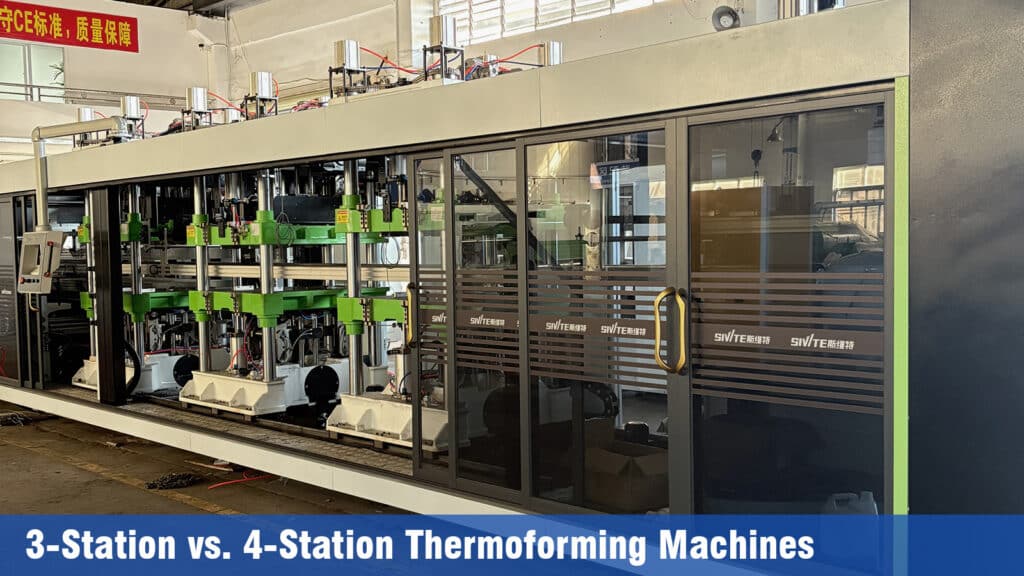
Choosing between a three-station and a four-station thermoforming machine is a critical decision that impacts production efficiency, product quality, and overall economic returns. While both are workhorses of the plastic packaging industry, they cater to distinct production requirements. This guide provides a detailed analysis of the key differences—covering station configuration, suitable products, costs, and advantages—to help you select the equipment that best aligns with your production goals.
To start with the conclusion: four-station thermoforming machines are generally designed for products with side holes or multiple perforations—prime examples being blueberry punnets and flowerpots. In contrast, three-station thermoforming machines are versatile, general-purpose units capable of handling any product that does not require extensive perforation.
Understanding the station configuration of thermoforming machines
A “station” refers to a dedicated area where specific production steps—such as heating, forming, punching/cutting, and stacking—are performed. The number of stations determines the workflow structure and the number of processes that can be carried out simultaneously.
The primary difference between three-station and four-station thermoforming machines lies in the number of stations and the allocation of functions: a three-station machine typically comprises forming, cutting, and stacking stations, whereas a four-station machine adds a punching station to the forming, cutting, and stacking setup, thereby enabling faster and higher-quality production of parts requiring holes.
Key difference
1、Workflow for 3-station and 4-station machines
A three-station thermoforming machine is typically configured as follows: forming, cutting, and stacking. After the plastic sheet is softened in the heating section, the forming station shapes it into the desired product; the cutting station then trims away excess material, and finally, a robotic arm stacks the finished products neatly for subsequent packaging.
The layout of a four-station thermoforming machine follows this sequence: forming, punching, cutting, and stacking. After the plastic sheet is softened by heating, it is shaped into the desired product at the forming station; holes are then punched at the punching station, and excess material is trimmed away at the cutting station; finally, a robotic arm stacks the finished products neatly. The overall process involves just one additional production step—punching—compared to a three-station machine.
2、Product Applications
Three-station equipment effectively handles standard packaging products—such as trays, meal containers, and clamshell fruit boxes—and is suitable for virtually any product without specialized requirements. Four-station equipment, featuring an additional punching station, is primarily designed for products requiring precision punching, such as blueberry punnets and flower pots.
3、Production speed and efficiency
Because the production process for a four-station machine is more complex and requires fully automated operation of the entire unit, its efficiency is 2–5 cycles per minute lower than that of a three-station machine; the exact difference depends on the specific process requirements and production complexity of your product.
4、Input costs
Adding workstations and advanced automation features entails higher costs. Three-station units are less expensive, typically costing 15–25% less than comparable four-station models. Furthermore, they have a smaller footprint (compact design) and simpler maintenance requirements.
5、Material Waste and Machining Precision
In reality, there is no fundamental difference between three-station and four-station machines; both are designed to manufacture the products we require. The distinction lies in production process requirements—certain specialized products simply necessitate four stations for completion. Consequently, having more stations does not result in increased waste; the amount of waste generated depends on the mold layout. If you would like to learn more about this, please refer to our other article: “How to Optimize Mold Layouts in Plastic Thermoforming Machines to Minimize Waste.”