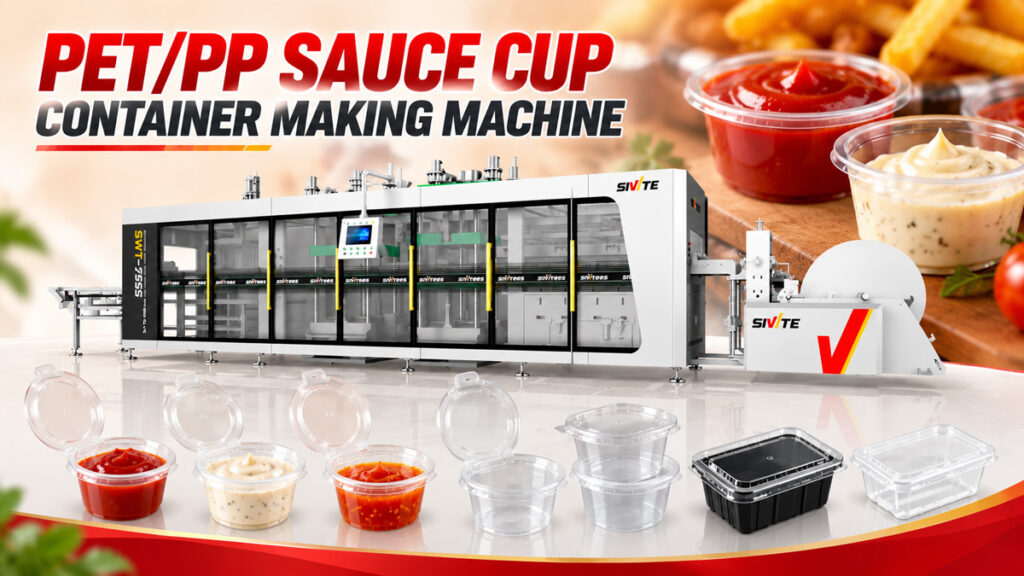
The small disposable sauce cups and dip cups used by fast food chains and delivery services look simple in size and structure, but keeping them leak-free with a secure lid fit actually demands quite a lot from the forming process. How are these small containers produced in bulk? The answer is a Sauce Cup Making Machine — specifically, a positive/negative pressure 3 station thermoforming machine. This article breaks down the production process for sauce cups, what capabilities the equipment needs, and its actual output efficiency.
Common Raw Materials for Sauce Cups
Sauce cups commonly use two materials: PET and PP. PET offers high clarity, suited for applications where the sauce color needs to show through, such as ketchup or salad dressing. PP has better oil and heat resistance, suited for products like chili oil or hot sauces that need some tolerance for temperature. Both materials can be processed on the same machine, with only heating temperature and forming parameters requiring adjustment.
The Production Process for Sauce Cups
The production process runs through three continuous steps — heating, positive/negative pressure forming, and punching-and-stacking. Although sauce cups are small, precision requirements at every step remain demanding.
Step 1: Heating and Softening the Sheet
PET or PP sheet first enters the heating oven, where upper and lower heating elements evenly warm it to softening temperature. Sauce cup molds typically have a very high cavity count (a single mold can hold dozens or even hundreds of cup cavities), so overall heating uniformity across the oven directly affects forming consistency for every single cup. Any localized underheating leaves that cup’s wall thinner, creating a hidden leak risk downstream.
Step 2: Positive/Negative Pressure Mold Closing and Forming
The softened sheet moves to the forming station, where the mold closes from above and below — positive pressure actively pushes from above while vacuum draws from below at the same time — evenly stretching the sheet into the cup body and the curled rim at the top. Dimensional precision at the cup rim (which mates with the lid to create the seal) needs to be tight — even a slight deviation in the rim can cause the lid to seal poorly once pressed on, leading to leaks during transport. The “push-and-pull” action of positive/negative pressure keeps the sheet stretching evenly even inside small, deep cavity structures, giving noticeably more consistent wall thickness than vacuum forming alone — a key factor in keeping sauce cups leak-free.
Step 3: Punching, Separation, and Automatic Stacking
The formed cups are still attached to the sheet at this point. The punching station uses a cutting die to precisely separate each individual cup, and the separated cups are automatically counted and neatly stacked by the stacking system, moving straight into packaging — with no manual transfer required anywhere in the process.
One Machine Produces Sauce Cups Across Multiple Sizes and Styles
The advantage of the 3-station positive/negative pressure thermoforming machine is that switching to a different mold is all it takes to produce different sizes and styles of sauce cups. While there are many specs and styles on the market, common types include:
● Small dip cups (15-30ml): For delivery packaging like chili oil or garlic sauce, portioned in small amounts
● Medium sauce cups (30-60ml): Commonly used for fast-food ketchup and salad dressing packaging
● Compartmentalized sauce cups: With 2-3 separate sections in a single cup, suited for meals that pair with multiple dip options
● All-in-one sauce cups with attached lid: Cup and lid formed together in a single mold, reducing the need for a separate lid-fitting step
Regardless of how capacity and style vary, the machine itself doesn’t need to be replaced — only the forming mold needs adjusting, substantially lowering equipment investment for producers running multiple sauce cup specs.
Production Efficiency Reference
A well-configured positive/negative pressure 3-station thermoforming machine typically reaches a forming speed of 40-55 cycles per minute when processing small, high-cavity-count products like sauce cups. Because mold cavity counts run high (commonly dozens to over a hundred cavities per mold), hourly output can reach roughly 30,000-80,000 cups, depending on cup size and cavity count. The entire process runs fully automated from heating to stacking, and one machine usually only needs a single worker for end-of-line packing, significantly reducing labor cost compared to a manual, step-by-step production setup.
Whether it’s a 15ml small dip cup, a compartmentalized sauce cup, or an all-in-one lid design, sauce cups are all produced through the same heating-forming-punching process on one positive/negative pressure 3-station thermoforming machine, just with different molds. Positive/negative pressure mold closing ensures even stretching and precise rim sealing even in small, deep-cavity structures, directly solving the industry pain point of leaks. Output above 30,000 units per hour, with just one worker needed for packing, lets sauce cup manufacturers meet demand from the delivery and fast-food industries with lower labor cost and higher product reliability.