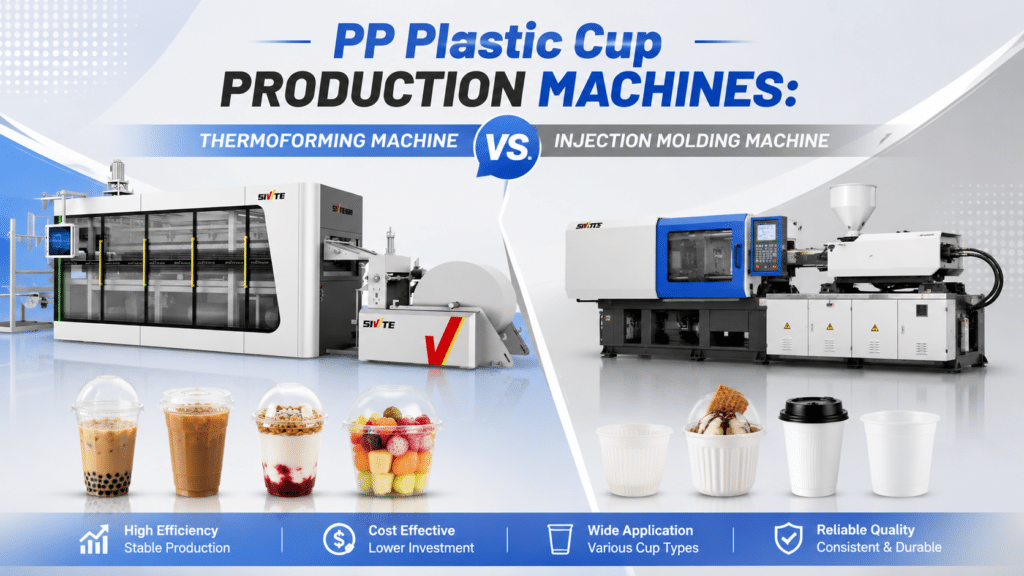
To start with the conclusion: if you are producing plastic cups and prioritizing high quality regardless of cost, choose injection molding; however, if you are aiming for high efficiency and strict cost control, a plastic cup thermoforming machine is the top choice.
Of course, this does not mean that plastic cups produced by thermoforming machines are of inferior quality; rather, the process offers advantages in specific areas. This guide provides a detailed analysis of both manufacturing methods—covering operating principles, cost investment, differences in product performance, and suitable applications—to help you make an informed choice.
First Things First: How Each Process Works
Thermoforming – Starting with a Sheet
Thermoforming is fundamentally a sheet-based process. It doesn’t start with pellets going directly into a machine—it starts with a roll of plastic sheet that’s been extruded earlier .
The workflow looks like this :
Sheet Feeding: A roll of PP sheet (typically 0.3-2mm thick) is fed into the thermoforming machine.
Heating: The sheet passes between banks of infrared heaters, softening it to a rubbery state without melting it completely .
Forming: The softened sheet is drawn over or into a mold using vacuum (negative pressure) or positive air pressure. Many machines also use a plug assist—a mechanical plunger that pushes the sheet into the mold before vacuum is applied .
Cooling & Trimming: The formed sheet is cooled, and individual cups are punched out from the web of plastic. The remaining skeleton (trim) is typically reground and recycled back into sheet production .
Modern high-speed thermoforming machines can run at 30-40 cycles per minute, with each cycle producing dozens of cups from a single sheet .
Injection Molding – Starting with Pellets
Injection molding takes a completely different route. It starts with plastic pellets (or granules), not sheet.
The workflow :
Melting: PP pellets are fed into a heated barrel, where a screw melts and homogenizes the plastic under high pressure.
Injection: The molten plastic is injected under high pressure into a closed steel mold cavity.
Cooling: The plastic cools and solidifies inside the mold.
Ejection: The mold opens and the finished cup is ejected—one complete, single-piece part.
Injection molding produces cups directly from raw material in one step, whereas thermoforming requires an extrusion step first (making the sheet), then the forming step
Differences in product performance(Real Customer Case Studies)
Here is some real-world data from the production workshop of a Cambodian client who uses our plastic cup making machines. Their factory produces both injection-molded and thermoformed cups; let’s take a look at the actual differences between the plastic cups produced by these two distinct manufacturing processes.
Wall Thickness and Uniformity
Thermoformed cups inherently have less uniform wall thickness. Because the sheet stretches to conform to the mold, the material becomes thinner in deep-draw areas—typically the sidewall of a cup. The result? A cup that may feel uneven in your hand, with a thicker rim and thinner body .
Injection molded cups, by contrast, have highly uniform wall thickness (typically within ±0.1mm) . The molten plastic fills the cavity evenly because it’s injected under pressure. This gives the cup a more consistent feel and greater structural integrity.
As thermoforming technology has advanced, the issue of uneven cup wall thickness has been resolved; the technology has now been almost universally adopted for key applications such as milk tea and coffee, with product quality fully meeting standards.
Material Properties:The two processes use different PP grades:
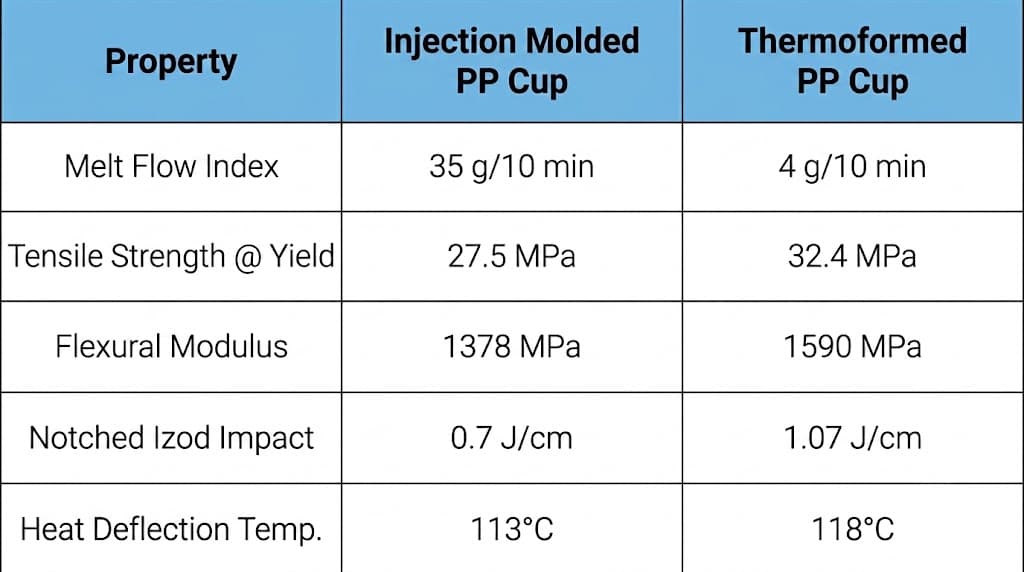
The thermoformed cup uses a higher molecular weight PP (lower melt flow index), which makes the material inherently tougher and more impact-resistant. The injection molded cup uses a lower molecular weight PP that flows more easily into the mold but is more brittle.It offers superior transparency. Thermoformed cups have thinner walls and significantly higher light transmission, providing a better visual appeal when filled with beverages like fruit juice or coffee.
Cost Structure – What You're Really Paying For
In terms of initial investment and operational costs, thermoforming machines offer a distinct edge, with main equipment costs being 25% to 40% lower than those of traditional injection molding machines. Crucially, thermoforming delivers far lower long-term running costs thanks to highly economical tooling: its molds are typically machined from easily workable aluminum—costing between $1,000 and $10,000 with high cavity capacity (10–50+ cavities)—whereas injection molding requires precision-machined hardened steel to withstand extreme pressure, driving mold costs up to $5,000 to over $100,000.
Which Should You Choose?
The decision isn’t about which process is “better”—it’s about which one fits your product requirements and business model.
Choose Thermoforming If:
1.You’re producing thin-walled disposable cups in high volume.
2.Your cup design is relatively simple (no complex undercuts, handles, or threads).
3.You need better impact resistance (e.g., cups that will be dropped or handled roughly).
4.There is a wide range of cup models and specifications, and you are looking for lower mold-making costs.
Choose Injection Molding If:
1.Your cups need consistent wall thickness for stacking or hot-fill applications.
2.You require complex features like handles, integrated threads, or detailed geometry.
3.You want a premium feel with excellent surface finish .
4.Stable, long-term, high-volume production of a single specification, with no need to consider mold costs.
If you are still unsure about which product to choose after reading this, feel free to send me your samples, and I can provide a comprehensive analysis and production implementation plan for you.
Frequently Asked Questions
Q: Which is cheaper: thermoforming or injection molding for plastic cups?
A: Thermoforming has a much lower upfront tooling cost ($500-$15,000 vs. $10,000-$300,000+ for injection molding).
Q: What material is used for thermoforming vs. injection molding?
A: Thermoforming starts with PP sheet, while injection molding starts with PP pellets. Thermoforming uses higher molecular weight PP (MFI ~4) compared to injection molding grades (MFI ~35).
Q: Are thermoformed cups weaker than injection molded cups?
A: Not necessarily. Thermoformed cups actually outperform injection molded cups in drop impact tests (no breakage at 163 cm vs. failure at 86 cm) and can meet the same top load requirements at 27% lighter weight.
Q: What are the main advantages of a plastic cup thermoforming machine?
A: Plastic cup thermoforming machines offer lower tooling costs, faster design iterations, better impact resistance, and suitability for smaller production runs compared to injection molding.
Q: When should I choose thermoforming over injection molding for PP cups?
A: If the cup requires high quality and features a complex structural design, choose an injection molding machine. If you are producing standard disposable cups and prioritize high efficiency and cost-effectiveness, choose a thermoforming machine. This serves only as a preliminary assessment.