Learn how to manufacture plastic coffee cups using plastic cup forming machines. Gain insight into the thermoforming process, production capacity, and investment costs associated with equipment for producing disposable plastic coffee cups.
The Heart of Production – The Plastic Cup Making Machine
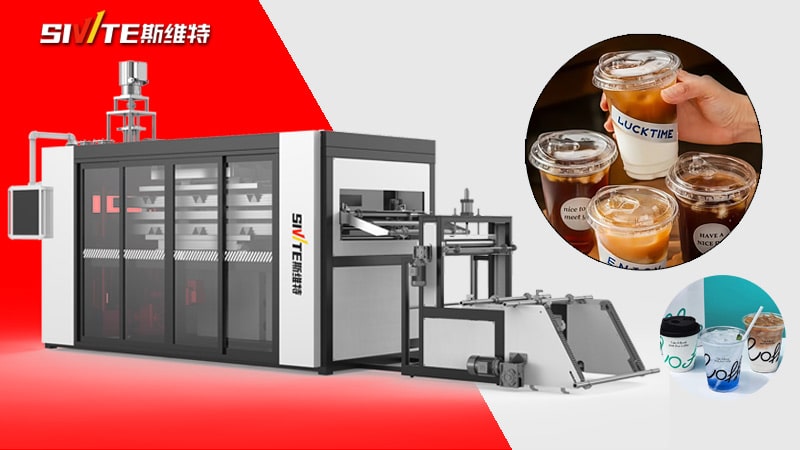
Most disposable plastic coffee cups are produced using thermoforming technology. A plastic cup making machine in this category takes a roll of plastic sheet and transforms it into finished cups through a continuous process .
The machine integrates several operations into one automated workflow: sheet feeding, heating, stretching, forming, cutting, and stacking. A single fully automatic plastic cup making machine can complete the entire cycle in one continuous operation.
Key workflow of a plastic cup making machine:
Sheet feeding – plastic sheet is pulled from a roll
Heating – infrared heaters soften the sheet to forming temperature
Forming – the softened sheet is pressed into mold cavities using positive pressure or vacuum
Trimming – formed cups are cut from the sheet web
Stacking – finished cups are counted and stacked automatically
Some advanced disposable plastic coffee cup machines come with integrated robotic stacking and counting systems, reducing manual labor and improving throughput
What Materials Can a Plastic Cup Making Machine Process?
A versatile plastic cup making machine can handle a wide range of materials. This is crucial because different coffee cup applications require different material properties.
Common materials include :
PP – Polypropylene, suitable for hot beverages, offers good heat resistance
PET – Clear, lightweight, ideal for cold drinks; recyclable
The sheet thickness typically ranges from 0.2mm to 3.0mm, with most coffee cups using material in the 0.3-1.5mm range .
For thermoforming applications, PP typically has a melt flow rate between 1.2 and 5 g/10min, which provides the stiffness and melt stability needed for consistent cup production
How a Disposable Plastic Coffee Cup Machine Works
This machine processes the material through sheet feeding, heating, forming, cutting, and automatic cup sorting and stacking, ultimately producing high-quality disposable plastic coffee cups.
Production Capacity
Taking a 95mm-diameter cup as an example, the SWT-750 plastic cup making machine—featuring a 17-cavity mold and operating at a standard cycle time of 3 seconds—can produce over 20,000 coffee cups per hour; with a 10-hour daily production schedule, it easily yields hundreds of thousands of cups, achieving an efficiency several times higher than that of other coffee cup production machines.
How to Choose the Right Plastic Cup Making Machine
When evaluating a plastic cup making machine for your production line, consider these factors:
1. Production Volume
Low volume: Entry-level machines at 20-28 cycles/min
High volume: Premium models reaching 35+ cycles/min with 8+ forming stations
2. Cup Size and Depth
Standard cup depth: up to 120mm
Deep-draw applications: up to 220mm
3. Material Requirements
Ensure the machine supports your target materials (PP for hot drinks, PET for cold drinks, PLA for biodegradable options)
4. Automation Level
Semi-automatic: Lower cost, more manual intervention
Fully automatic: Higher investment, reduced labor requirements
AI-assisted: Premium option with predictive maintenance and precision optimization
5. Energy Efficiency
Compared to traditional hydraulic plastic cup-making machines, the new servo plastic cup-making machines offer significantly lower energy consumption; some advanced models can achieve energy savings of 30%.
Frequently Asked Questions
Q: What is a plastic cup making machine?
A: A plastic cup making machine is a thermoforming machine that converts plastic sheet rolls into finished disposable cups through a continuous process of heating, forming, cutting, and stacking. It’s the primary equipment used for producing disposable coffee cups, yogurt cups, and other beverage containers .
Q: What’s the difference between thermoforming and injection molding for plastic cups?
A: Thermoforming starts with plastic sheet and is faster for thin-wall disposable cups, with lower tooling costs. Injection molding starts with pellets and is better for thicker, premium cups and complex geometries. Thermoforming typically dominates the disposable coffee cup market .
Q: How fast can a disposable plastic coffee cup machine produce cups?
A: Production speed depends on cup size and machine configuration. Typical speeds range from 20 to 35 cycles per minute, with each cycle producing multiple cups from a multi-cavity mold. Advanced models can achieve up to 20000 cups per hour .
Q: What materials can a plastic cup thermoforming machine process?
A: Most machines can process PP, PS, PET, PVC, HIPS, and biodegradable materials like PLA. This flexibility allows one machine to produce different types of cups for different applications .
Q: How much does a plastic cup making machine cost?
A: Entry-level machines start around $25,000-$50,000, mid-range automatic machines range $45,000-$80,000, and high-capacity servo-driven systems can cost $100,000-$140,000+