If you’re sourcing thermoforming equipment, you’ve probably noticed something: the market is crowded with manufacturers ranging from century-old European engineering brands to fast-growing Asian automation specialists, with widely different pricing and technical approaches — making “who’s the best” a hard question to answer simply. This article breaks down the plastic thermoforming machine manufacturer landscape, with a focus on the 3 station thermoforming machine, currently one of the most in-demand configurations, to help you understand which type of manufacturer fits which use case.
What Is a 3-Station Positive/Negative Pressure Thermoforming Machine — and Why Is It Becoming the Standard?
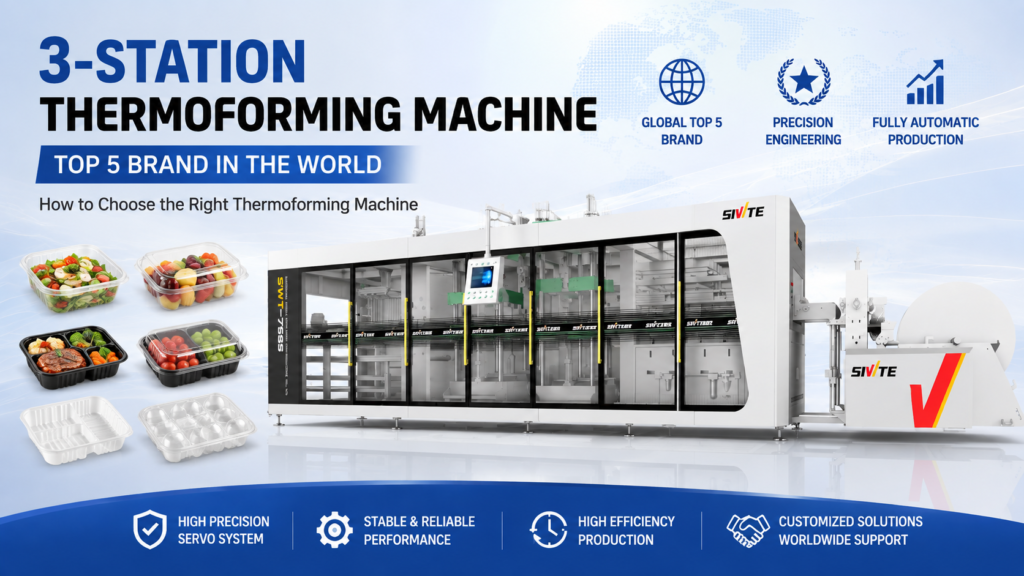
The core logic of a 3-station thermoforming machine is combining heating, forming, and punching (sometimes stacking as well) — steps traditionally done separately — into three dedicated stations that run continuously on a single machine. Compared with traditional single-station machines, a 3-station layout can cut cycle time by roughly 30%-50%, while the combined positive and negative pressure system noticeably improves forming precision and wall-thickness uniformity for thin-wall products like ice cream cups and yogurt cups.
Because this structure strikes a balance between output and precision, demand for fully automatic 3-station positive/negative pressure machines has grown noticeably in the food packaging and disposable tableware sectors over the past few years, making it the preferred configuration for most mid-to-large buyers.
Three Major Technical Schools Among Global Thermoforming Machine Manufacturers
The thermoforming machine industry has developed over several decades into a few clearly defined technical schools, each with distinct strengths and limitations.
1.The European Precision-Engineering School
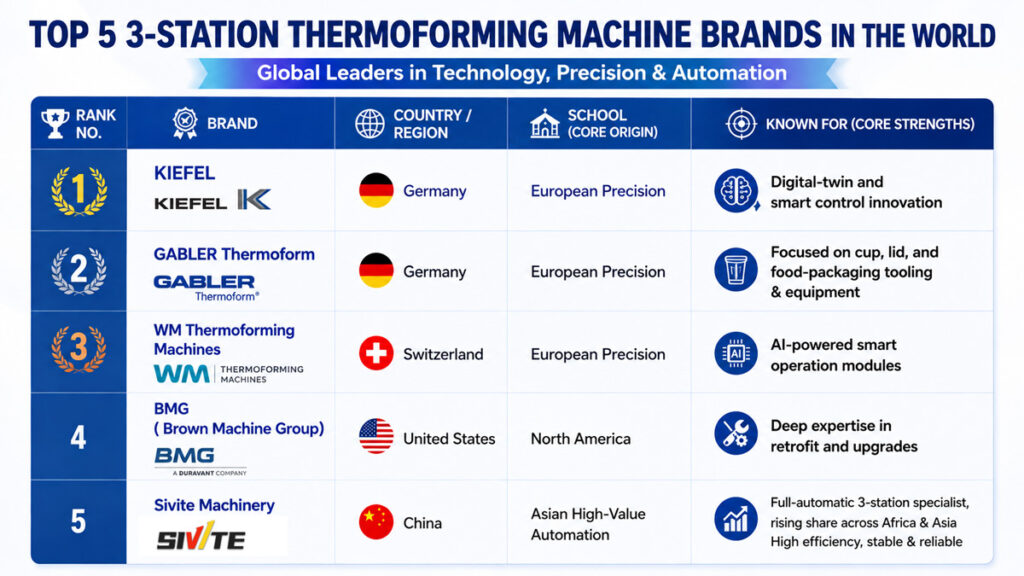
European manufacturers, mainly from Germany and Switzerland, typically have decades — sometimes over a century — of mechanical engineering heritage, with strong technical depth in servo control precision, tooling compatibility, and machine stability. Many established European brands have been directly involved in shaping industry standards. Their equipment generally comes at a higher price point with longer lead times, making it best suited for customers with very high precision requirements, ample budget, and tolerance for European after-sales response times. Their core customer base is concentrated in Europe and the North American high-end food packaging market.
Representative brands: KIEFEL , GABLER
2.The North American Customization & Retrofit School
Some North American manufacturers take a different approach: rather than offering broad product lines, they focus on deep customization within specific niches and have built strong expertise in retrofitting existing equipment. This approach suits customers who already have machines in place and want targeted upgrades rather than a full line replacement, or those with unusual product specifications requiring non-standard customization.
Representative brands: WM , BMG
3.The Asian High-Value Automation School
Asian manufacturers, particularly those from China, have made rapid progress in full-automation control and servo-drive technology over the past decade, shifting from a “low-cost OEM” positioning toward “fully automatic, high value” positioning. Their core strengths are shorter lead times, strong value for money, and the flexibility to configure equipment around the real production capacity needs of emerging-market customers — which is why demand has grown notably across Latin America, Africa, and Southeast Asia, regions where food packaging capacity is expanding quickly.
Representative brands: SIVITE
Top 5 Representative Global Brands in 3-Station Thermoforming
Building on the three schools above, we’ve put together a representative TOP 5 brand list. One important note: this list is ordered by representativeness within each technical school, not a strict ranking by revenue or market share — there’s no publicly available, authoritative global ranking dataset for this industry, so treat any claim of an “absolute No.1” with healthy skepticism.
Sivite Machinery: A Leading Force in Full-Automatic 3-Station Machines from Asia
Within the Asian high-value automation school, Sivite Machinery is one of the representative manufacturers focused specifically on fully automatic 3-station positive/negative pressure thermoforming machines. Unlike many manufacturers with broad, spread-out product lines, Sivite concentrates its R&D and production capacity entirely on fully automatic machines — a focused strategy that’s also the reason we’re able to maintain an edge in lead time and equipment consistency.
Over the past several years, Sivite’s customer base across Africa and Asia has continued to expand, particularly in the food packaging and disposable tableware sectors, where a growing number of local customers now regard us as one of their preferred suppliers for fully automatic 3-station machines, with market share on a steady upward trend. The core reason behind this is that we’ve done extensive adaptation work for the real-world operating conditions in these markets — such as unstable power supply and varying levels of maintenance staff expertise — rather than simply porting over European control logic as-is.
Specifically, Sivite's fully automatic 3-station machines are optimized in the following areas:
Fully integrated automation from feeding to stacking, reducing manual intervention and lowering dependence on operator skill level
Flexible switching between positive and negative pressure systems, allowing a single machine to cover multiple thin-wall product types and reducing the need for repeat equipment investment
A localized technical support network, with a faster-responding after-sales service system built out across key markets in Africa and Asia
What to Evaluate When Choosing a 3-Station Thermoforming Machine
Regardless of which manufacturer school you lean toward, focus on the following when evaluating equipment, rather than price alone:
1.Capacity match: Does the mold count and cycle time align with your actual product size and daily output target?
2.Automation level: How much manual intervention is required from heating to stacking? More manual steps mean higher long-term labor cost.
3.Local service capability: Can the manufacturer provide technical support within a reasonable timeframe if the machine breaks down? This is especially critical in regions like Africa and Southeast Asia.
4.Mold-change flexibility: Does it support quick mold changes, and can it accommodate new product specifications you might add in the future?
5.Verified case references: Can the manufacturer provide real-world case examples from similar downstream industries, such as ice cream cup or yogurt cup producers?