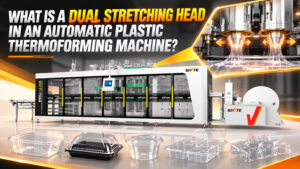
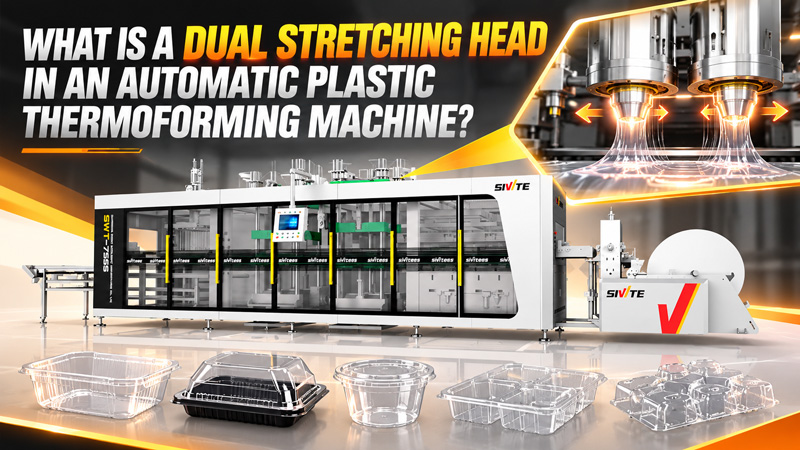
A dual stretching head on an Fully automatic plastic thermoforming machine spreads the stretching load across two drive points instead of one. This reduces uneven force and plate tilt, which helps stabilise forming on large molds. It does not make a machine faster by itself, but it creates better conditions for consistent quality and long-term reliability.
What Is a Dual Stretching Head?
In thermoforming, the stretching mechanism moves the plug-assist or stretching plate into the heated sheet before vacuum and air pressure complete the forming. On a conventional machine, one side or one central drive handles this movement. In a Dual Stretching Head design, two drive and guide sets work in sync, usually on both sides of the mold area.
The idea is simple: the larger the mold, the longer the lever arm and the larger the area the mechanism must cover. Two points of support are more stable than one.
Why Large Molds Need Balanced Force
Such as a 750 × 850 mm class model like the SWT-7585 plastic thermoforming machine, handles bigger mold plates, more cavities and heavier stretching plates. When the driving force sits on one side, even a small offset can produce a bending moment on the guide components. Over thousands of cycles, that moment shows up as wear, vibration and drifting alignment.
A dual design shares the load. Each drive and guide set carries roughly half of it, so there is less concentrated stress on any single component.
6 Practical Benefits of a Dual Stretching Head
1. More Balanced Force for Large Molds
Large molds mean the stretching mechanism covers a wider area. With a properly designed dual-side drive, force distribution improves and the risk of one-sided loading drops.
Customer value: better suited to large sheets and heavy-load forming.
2. Smoother, More Synchronised Stretching Motion
When the two stretching units have good synchronisation, guiding and rigidity, the risk of plate tilt, swing and uneven movement is reduced.Customer value: helps keep the forming action stable and limits the effect of mechanical instability on the product.
3. Lower Risk of Local Eccentric Load
A single-side drive on a large mechanism can create a significant eccentric moment. A dual drive shares the load, lowering the stress on some transmission and guide parts.Customer value: supports longer machine life and mechanical durability.
4. Better Forming Consistency
Stretching is a key factor in how sheet material is distributed. When stretch position, stroke, speed and temperature are properly matched, thickness differences between areas of the part can be reduced. For food containers, many buyers aim to keep wall thickness variation within roughly 10–15% across a part, though the real result depends on material, draw ratio and mold design.Customer value: for large food trays and fresh-produce boxes, forming stability becomes an easier quality target.
5. Creates Conditions for High-Speed Running and Process Tuning
If the dual stretching mechanism achieves precise synchronisation and works in coordination with heating, mold closing, vacuum and positive pressure systems, it creates conditions for cycle-time optimisation.Customer value: helpful for later cycle optimisation. However, dual stretching alone does not automatically mean faster speed.
6. Stronger Differentiation for Large-Format Equipment
For large machines like the 7585 class, buyers usually focus on mechanical rigidity, stretching stability, mold compatibility and long-term reliability.Customer value: gives sales teams a way to explain product value through mechanical design and reliability, rather than price alone.
What to Check When Evaluating a Dual Stretching Head
Not every dual-head design performs the same. Before choosing an automatic plastic thermoforming machine, ask the supplier about:
● Synchronisation method (mechanical linkage, servo-electronic sync, or hydraulic balance)
● Guide rail and bushing specification, and the plate’s parallelism tolerance
● Stroke and speed adjustability for different product depths
● Mold size compatibility with your current and planned products
● Maintenance access and spare parts for both drive sets
Ask for a trial run with your own mold and material where possible. Thickness distribution on real parts tells you more than any brochure.
Where Dual Stretching Makes the Most Sense
Dual stretching heads are most valuable on large-format forming: big food trays, fresh-produce boxes, large clamshells and deeper-draw containers in PET, PP or PS. For small cups or shallow lids on small molds, a single well-designed stretching unit may already be enough. The right choice depends on your product size, draw depth and output target.