
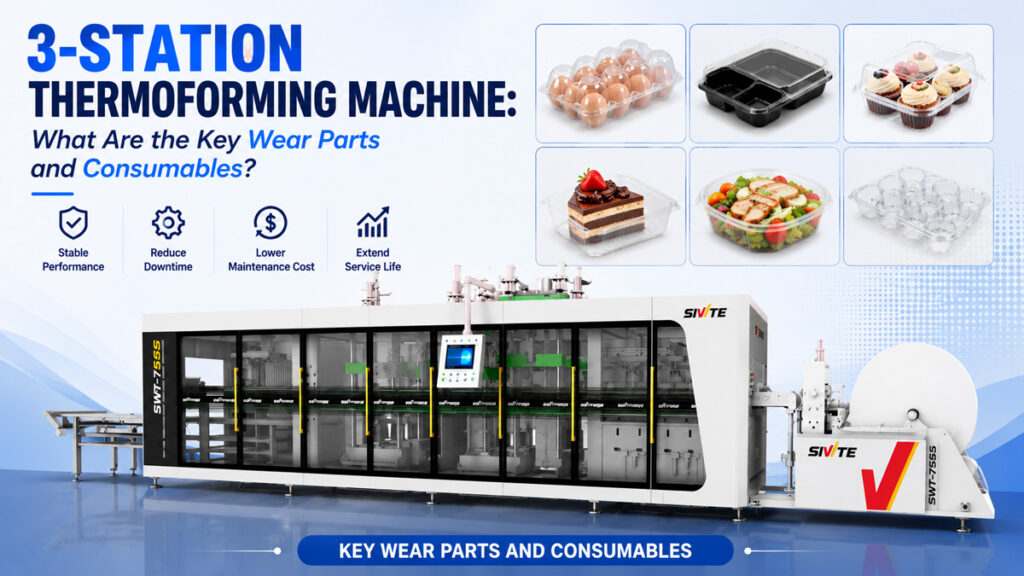
Many buyers evaluating a 3-station thermoforming machine put most of their budget planning into sheet material and the machine itself. But during actual operation, beyond the sheet, there’s a whole category of Thermoforming machine consumables — cutting dies, heating tiles, mufflers, pressure regulator valves, lubricating oil, and more — that gradually wear down or get used up over time. If spare parts for these aren’t stocked in advance, a sudden failure during production can mean hours or even longer of downtime, which directly hits delivery schedules. This article walks through the common wear parts and consumables on a fully automatic 3-station thermoforming machine, helping you plan spares before purchase and during ongoing use.
Why Planning for Wear Parts Matters as Much as Machine Selection
A 3-station thermoforming machine runs continuously at high speed, with heating, forming, and punching all operating simultaneously across several subsystems — high-temperature components, pneumatic systems, and mechanical drive components. A meaningful portion of the parts in these subsystems are consumable by nature — not a quality issue, but wear and aging that naturally occurs with normal use.
If a buyer only focuses on the upfront cost of the machine and doesn’t factor wear-part replacement frequency and spare-part cost into the total cost of ownership, it’s easy to end up in a situation where “the machine was cheap, but downtime cost is high.” A more reasonable industry practice is to prepare a basic spare parts kit at the same time the machine arrives, covering the highest-turnover wear items.
Core Wear Parts and Consumables on a 3-Station Thermoforming Machine
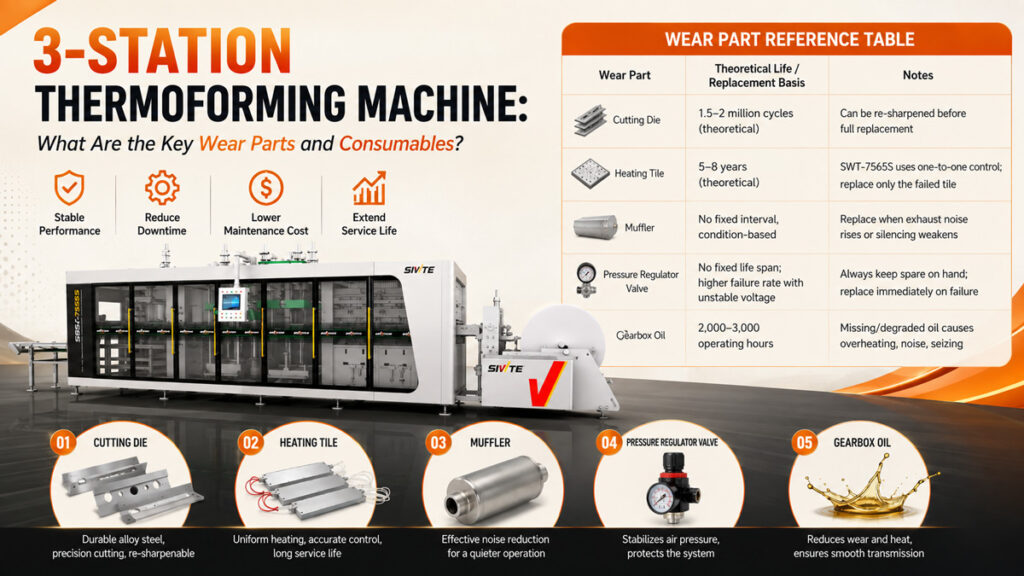
1. Cutting Dies (Punching Molds)
Cutting dies are the core components at the punching station that make direct contact with the sheet to perform cutting — and they’re among the fastest-wearing parts. The cutting edge gradually dulls under long-term, high-frequency punching. Once dulled, it tends to produce burrs, uneven cuts, and can even tear the sheet or fail to cut through cleanly.
The theoretical service life of a cutting die is roughly 1.5-2 million punching cycles, though actual wear speed depends heavily on the shape of the product being cut and sheet hardness. A dulled edge doesn’t automatically mean the die needs replacing right away — in most cases the edge can be re-sharpened and put back into service, with a full replacement only needed once it’s worn beyond the point of re-sharpening. This approach meaningfully lowers long-term cost.
2. Heating Tiles (Ceramic Heating Elements)
Heating tiles are the core elements at the heating station responsible for evenly warming the sheet, typically arranged in an array inside the heating oven. Heating tiles have a relatively long theoretical service life of roughly 5-8 years, and under normal use they rarely cause problems.
Worth noting: our SWT-7565 3-station thermoforming machine uses a one-to-one independent temperature control design, where each heating tile is controlled by its own individual circuit. This means that if a single tile in the array fails, only that one tile needs replacing — unlike some traditional machines where an entire group or row has to be swapped out. This saves on spare-part cost and significantly cuts down troubleshooting and repair time.
3. Mufflers (Pneumatic Exhaust Silencers)
The positive/negative pressure system on a 3-station thermoforming machine relies on numerous pneumatic components, and mufflers are installed at exhaust ports to reduce the noise generated when pneumatic valves release air. The filter material inside a muffler gradually clogs with oil residue and dust over time.
Mufflers don’t have a fixed replacement interval — we recommend checking them periodically. Once you notice exhaust noise becoming noticeably louder or the silencing effect weakening, that’s a sign the interior is clogged and it’s time to replace it, before it continues to slow valve exhaust speed and drag down the overall cycle rate.
4. Pressure Regulator Valves (Pneumatic/Hydraulic)
Pressure regulator valves stabilize incoming air or hydraulic pressure to the working pressure each system needs, making them a key component for forming precision. Unlike other wear parts, pressure regulator valves have no clearly defined service life — their failure is more directly tied to power supply stability. Once workshop voltage becomes unstable or fluctuates, the probability of valve failure rises sharply.
Because failures can happen somewhat unpredictably, pressure regulator valves are one of the parts we recommend always keeping in stock as spares — replace immediately if it malfunctions, to avoid pressure fluctuations that affect the stability of positive/negative pressure forming and cause uneven sheet thickness or incomplete local forming.
5. Lubricating Oil and Grease
The lubrication system covers the gearbox, guide rails, chains, and bearing housings — a continuously consumed item rather than a one-time wear part. The principle behind lubrication is straightforward: it forms a film of oil between two surfaces that rub against each other, keeping metal from directly contacting metal. This reduces friction and wear, keeps the machine running more smoothly, and saves energy.
We generally recommend changing gearbox oil every 2,000-3,000 operating hours. If lubricating oil is missing or has degraded, the most direct consequence is components overheating from direct friction and generating louder abnormal noise — and if ignored long enough, this can cause parts to seize up and fail outright, with repair costs far exceeding the cost of a timely oil change.
Wear Part Reference Table
The figures above are theoretical reference values. Actual service life varies based on daily operating hours, workshop environment, and material characteristics — adjust your spare-parts plan dynamically based on your equipment’s real operating data.
Case Study: A Year-Old Machine with an Unstable, Noisy Cutting Station — Traced to Two Wear Parts
A customer reported that after about a year of use, their punching station started showing unstable motion and noticeably louder noise, with products frequently coming out with rough edges, burrs, or failing to cut through cleanly. Our after-sales team inspected the machine on-site and identified two overlapping wear-part issues:
First, the machine had gone without lubricating oil for a long time, causing the punching station’s drive components to bind and deliver uneven cutting force — the main source of the increased noise. Second, the cutting die was severely worn, with an edge that was no longer sharp, directly causing the drop in cutting quality with burrs and incomplete cuts.
To address both issues, our after-sales team replenished the lubricating oil and replaced the cutting die. Once this was done, the machine’s production performance immediately returned to a smoothness close to a new unit, noise dropped noticeably, and cutting quality returned to normal. This case is a good example of how problems that look like general “machine aging” can often be traced back to just one or two wear parts that weren’t maintained or replaced on schedule.
How to Plan Wear-Part Spares When Purchasing Equipment
- Separate wear parts with a fixed interval from those judged by condition: Cutting dies, heating tiles, and lubricating oil have relatively clear theoretical lifespans and can be planned on a schedule. Mufflers and pressure regulator valves are better judged by actual condition (noise, voltage stability) — and for pressure regulator valves in particular, we recommend always keeping at least one spare on hand regardless of current condition
- Favor machine designs where components can be replaced independently: For example, the SWT-7565’s one-to-one heating tile control design means only the failed tile needs replacing, not the whole group — a clear advantage for long-term spare-part cost and repair efficiency
- Keep a wear-part replacement log: Track installation and replacement dates for each part, gradually building your own line’s real wear data rather than relying solely on the manufacturer’s theoretical reference values