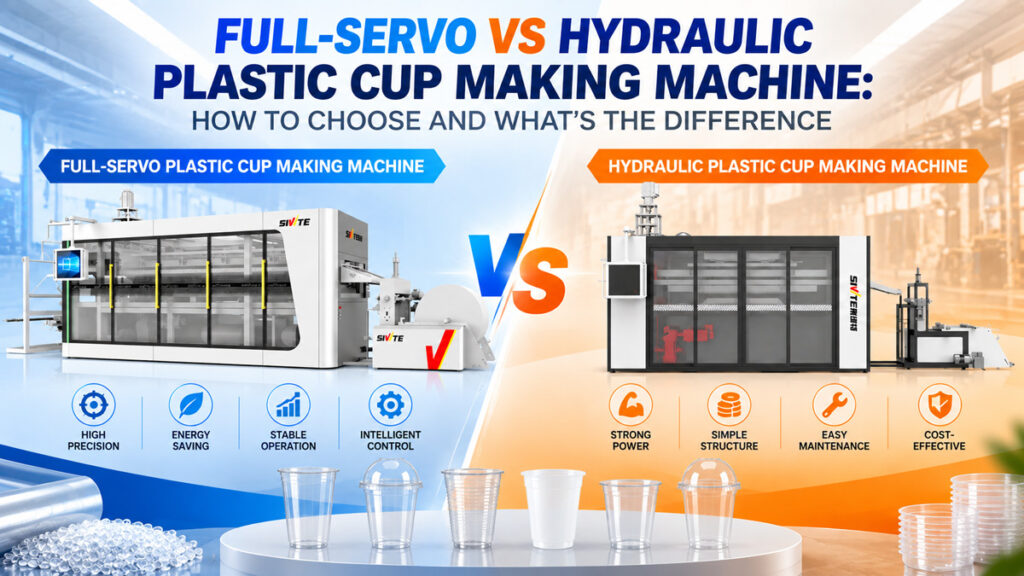
If you’re evaluating a plastic cup making machine, hydraulic and full-servo are essentially the two options you’ll run into. Cups produced by either drive type may look similar at first glance, but the gap in long-term operating cost, maintenance complexity, and forming precision is actually quite significant. This article breaks down the core differences between a full-servo plastic cup making machine and a hydraulic plastic cup making machine, helping you decide which one fits your operation.
Core Working Principle Differences Between Hydraulic and Servo Cup Machines
To understand the gap between them, you first need to understand that they generate power in fundamentally different ways.
How a Hydraulic Cup Machine Works
A hydraulic plastic cup making machine relies on a hydraulic pump continuously driving hydraulic oil, pushing the mold open and closed and completing forming actions through oil cylinders. The pump typically needs to keep running regardless of whether power output is needed at that moment, which is the root cause of hydraulic systems’ higher energy consumption. Hydraulic oil generates significant heat during operation, and as oil temperature rises, its viscosity changes — which in turn affects the stability of pressure output.
How a Full-Servo Cup Machine Works
A full-servo cup machine uses servo motors to directly drive the mechanical structure through each action. The defining trait of a servo motor is “power on demand” — it only draws the corresponding electrical energy at the exact moment power output is needed, with energy consumption during idle or standby states being nearly negligible. Servo motors come with built-in encoders that provide real-time position and pressure feedback, allowing the control system to make millisecond-level adjustments based on that feedback.
Core Advantages of a Full-Servo Plastic Cup Making Machine
1. Energy Costs Can Be Reduced by 30%-50%
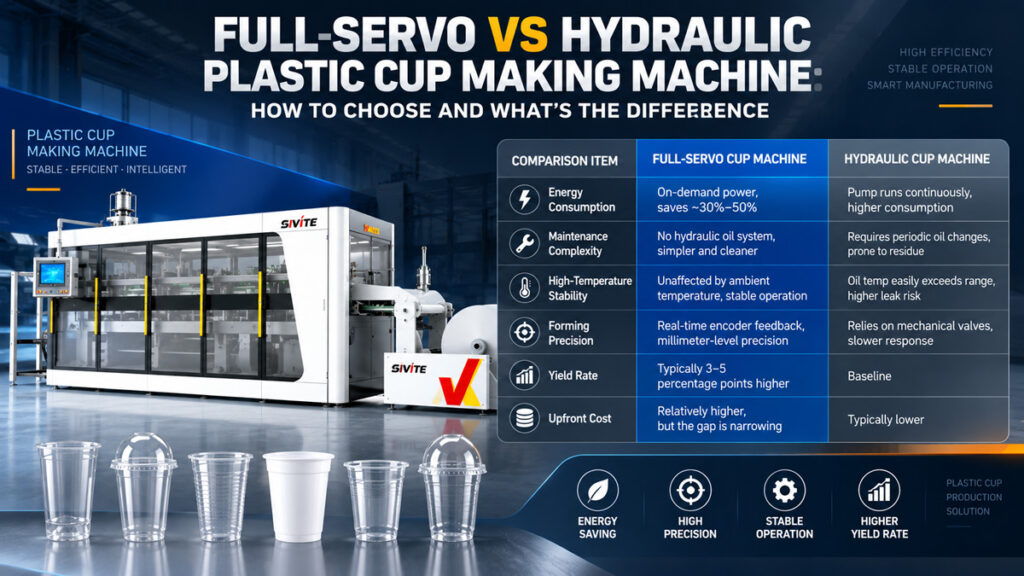
Because a hydraulic pump needs to keep running to maintain system pressure, it continues drawing power even when the machine is idle or between actions. A servo motor, by contrast, only outputs power on demand and draws almost no electricity when idle. Based on measured data from our customers, a full-servo cup machine with equivalent output typically cuts overall energy costs by 30%-50% compared to a hydraulic model — and over the long run, that savings adds up considerably, especially for factories running 24-hour continuous production, where the gap keeps widening the longer the machine runs.
2. Easier Maintenance and a Cleaner, More Hygienic Workshop
Hydraulic machines require periodic oil changes, which are time-consuming and labor-intensive — and the process itself often causes oil drips and spills, making it hard to keep the workshop floor and surrounding equipment clean over time. A full-servo cup machine has no hydraulic oil system at all, so daily maintenance mainly involves routine lubrication of drive components, meaning noticeably less overall maintenance workload and an easier-to-keep-clean workshop — especially important for food-grade plastic cup production, since workshop hygiene directly affects customer confidence in the product.
3. Unaffected by Hot Weather, Fewer Oil Leaks and Less Downtime
Hydraulic machines have a pain point that becomes especially obvious in summer: workshop ambient temperature is already high, and the hydraulic oil itself continuously generates heat during operation — the combination easily pushes oil temperature beyond its normal working range. Overheated oil causes viscosity to drop, making pressure output unstable, while seals also age faster under high heat, noticeably raising the likelihood of oil leaks. Once a leak occurs, it typically requires stopping the machine for repair, directly disrupting the production schedule.
A full-servo cup machine has no hydraulic oil at all, so there’s no issue with oil temperature fluctuating with ambient temperature — machine stability isn’t affected by season or workshop temperature. This is one of the main reasons factories in southern regions or hot climates have been gradually replacing hydraulic machines with full-servo models in recent years.
4. Higher Precision and Better Yield Rate
Servo motors come with built-in encoders that provide real-time feedback on pressure and position, achieving millimeter-level precision. This means every action — from mold opening and closing to forming pressure output — can be precisely controlled and corrected in real time, without forming consistency drifting due to pressure fluctuation over long operating periods. Hydraulic pressure control, by comparison, relies more heavily on mechanical valves and oil temperature conditions, and its precision adjustment response speed and stability don’t match a servo system’s.
Based on our customers’ actual production data, switching to a full-servo cup machine typically raises yield rate by 3-5 percentage points. For factories with high daily output, this improvement translates into a substantial gain when converted into actual production volume and scrap-cost savings.
Hydraulic vs Full-Servo Cup Machine Comparison Reference
Where a Hydraulic Machine Still Makes Sense
While full-servo machines have clear advantages in energy consumption, maintenance, and precision, hydraulic machines aren’t entirely without value. Hydraulic systems have some structural advantage in delivering large-tonnage, continuously stable output force. For certain applications requiring very high single-stroke force but with relatively relaxed requirements on energy consumption and precision, hydraulic machines typically come with a lower upfront cost, making them still a choice for some budget-constrained buyers. That said, as servo technology continues to improve and costs come down, this upfront cost gap is steadily narrowing.
How to Choose: Hydraulic or Full-Servo
If you’re in a hot climate, or your workshop runs at high ambient temperatures year-round, a full-servo cup machine effectively avoids the stability issues hydraulic systems face in heat, making it the safer choice
If your production demands high yield rate and forming precision, a servo system’s millimeter-level real-time feedback significantly reduces scrap caused by pressure fluctuation
If you prioritize total long-term operating cost over just the upfront purchase price, a full-servo machine’s savings on electricity and maintenance typically offset the price difference from a hydraulic machine within a reasonable payback period
If your budget is very tight and you have a specific need for high single-stroke force, a hydraulic machine is still a reasonable option to consider