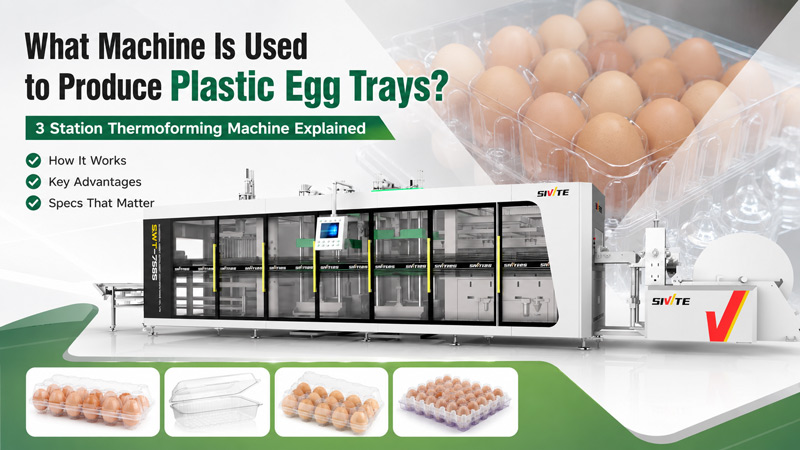
If you’re entering the plastic egg tray market, the first question you’ll run into is: which machine should you actually buy? Products priced anywhere from a few thousand to well over a hundred thousand dollars all get called “egg tray machines” — so where does the real difference lie? It mostly comes down to the number of stations and the level of automation, and the 3 station thermoforming machine is currently the most cost-effective and widely used configuration for small-to-mid scale egg tray production. This article explains how it works, how it compares to other machine types, and what specs actually matter when you’re choosing one.
How Are Plastic Egg Trays Actually Made?
Plastic egg trays are typically made from PP (polypropylene) or recycled PET sheet, pressed into the raised-and-recessed tray shape through thermoforming. The core cycle is simple: heat the sheet, form it into the mold, then punch and separate the finished trays. A Plastic Egg Tray Thermoforming Machine is a purpose-built version of this process, and it differs from general-purpose thermoforming machines (like those used for clear food containers) in mold structure and punching precision requirements.
How a 3-Station Thermoforming Machine Works
1.What Each of the Three Stations Does
A 3-station thermoforming machine splits the process into three independent stations, with the sheet advancing through them on a chain conveyor:
Station 1 — Heating: upper and lower infrared heater panels warm the PP or PET sheet in zones, ensuring even softening and avoiding holes or wrinkles from localized overheating.
Station 2 — Forming: the softened sheet enters the mold, where vacuum or air-pressure forming shapes the egg-tray cavities while the sheet cools and sets.
Station 3 — Trimming: the formed sheet is punched and separated from the surrounding skeleton (scrap frame), which is automatically collected for regrinding and reuse.
2.How It Differs From Single-Station Models
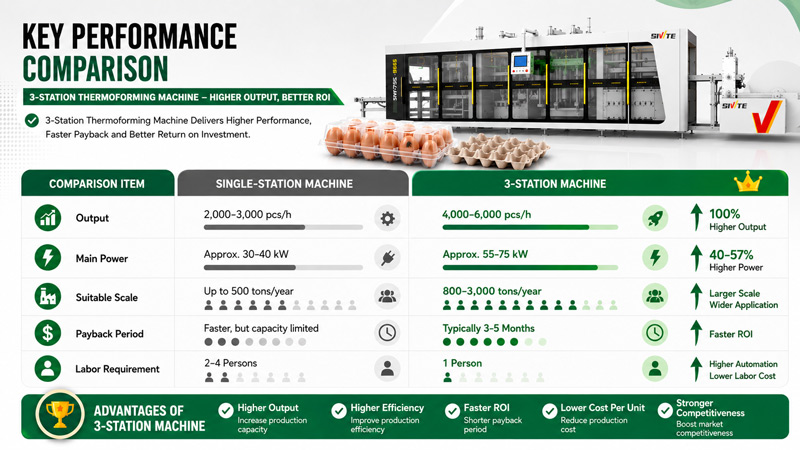
Single-station machines (heating, forming, and trimming all happen in one station, sequentially) are simpler and cheaper, but slower — typically 2,000-3,000 trays/hour — suitable for startups or sample runs. 3-station machines run the three actions in parallel across separate stations, cutting cycle time and pushing output to 4,000-6,000 trays/hour.
Key Performance Comparison
A Real Case: Capacity Upgrade for a Mid-Size Egg Tray Plant
An egg tray producer in Southeast Asia started with a single-station machine, running roughly 20,000 trays/day. As local supermarket and export orders grew, the single-station output ceiling quickly became a bottleneck. After upgrading to a 3-station thermoforming machine, daily output over the same 8-hour shift rose to approximately 42,000 trays, and the reclaim rate of trimmed scrap for regranulation improved from 70% to over 85% — thanks to more precise mold alignment and trimming — cutting overall material cost by roughly 6%-8%.
What to Ask Your Supplier Before Buying
When evaluating a 3 station thermoforming machine, look beyond motor power and output figures. Confirm whether the mold is purpose-built for egg trays (cavity count, customizable tray sizes), how many heating zones the infrared panels are divided into (more zones means more even heating), whether the trimming system uses servo-driven punching (which affects yield rate), and whether scrap-edge recovery is included as standard. These details determine actual on-site yield and operating stability far more than the headline output number on a spec sheet.
Conclusion: A Practical Starting Point for Most Buyers
If your annual capacity needs fall in the 800-3,000 ton range — too large for a single-station machine’s ceiling, but not yet justifying a 5-station investment — a 3-station plastic egg tray thermoforming machine offers the best balance between payback period, output, and operating stability, making it the most common mid-scale configuration in the market today.