If you’re sourcing a PET sheet extrusion line, screw selection is often the single most overlooked variable that determines output, energy cost, and final sheet quality. Many buyers compare quotations by motor power or line width alone, without realizing that the same extruder frame fitted with a high-speed screw for PET sheet extrusion machine can deliver 30%+ more throughput than a standard screw. This article breaks down the structural differences, performance data, and a real production case to help you match screw type to your budget and quality target.
The Role of the Screw in PET Sheet Extrusion
The screw is the “engine” of the extruder — it melts, mixes, pressurizes, and conveys PET resin (virgin or recycled flake) toward the die in a controlled, continuous flow. PET is a crystalline polyester with melt viscosity highly sensitive to temperature and shear, so screw geometry directly governs melt homogeneity, devolatilization (critical for removing moisture and low-molecular-weight byproducts in recycled PET), and the final sheet’s clarity and gauge tolerance.
Structural Differences
1.L/D Ratio and Compression Ratio
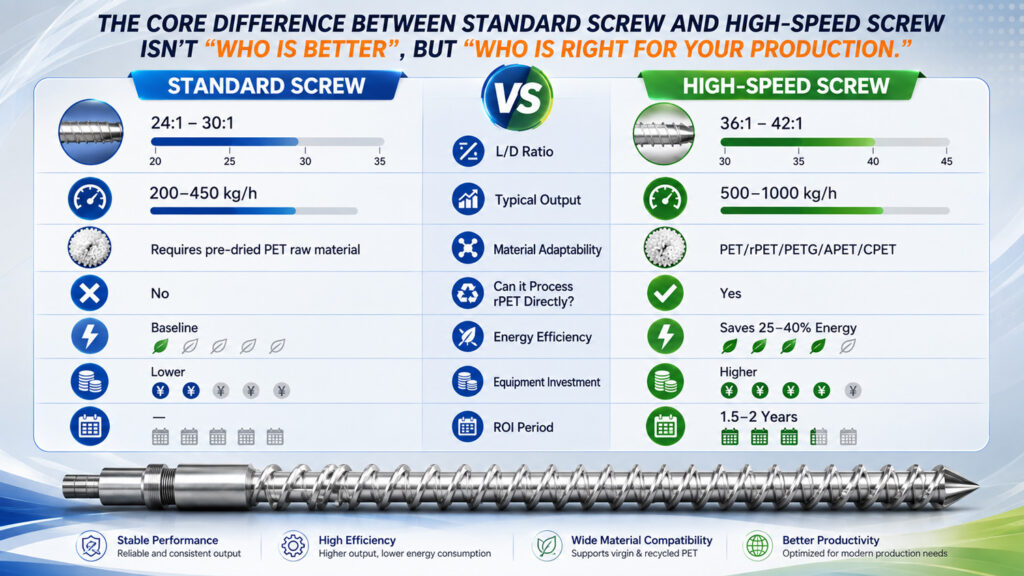
Standard screws typically use an L/D ratio of 28:1 to 32:1 with a compression ratio around 2.5:1, relying on a longer residence time to complete plastication. High-speed screws generally adopt a longer L/D ratio — 33:1 to 36:1 or more — with an optimized barrier section and mixing section that achieve uniform shear and melting in less time, enabling stable output at higher screw speeds.
2.Screw Speed and Output Capacity
Standard screws typically run at 60-90 rpm under normal production. High-speed screws operate stably at 120-150 rpm, with some customized configurations reaching 180 rpm. On a 1300mm-wide PET sheet line with a 132kW main motor, a standard screw yields roughly 750-800 kg/h, while a high-speed screw under comparable energy consumption reaches 1000-1100 kg/h — a 30%-35% output increase.
3.Material and Wear Resistance
Because high-speed screws operate under greater shear stress, they typically use bimetallic overlay technology — a nickel- or cobalt-based wear-resistant alloy welded onto a 38CrMoAlA substrate — achieving surface hardness above HRC60. Paired with a bimetallic barrel, service life commonly reaches 3-5 years depending on feedstock contamination levels, clearly outperforming standard nitrided screws.
A Real Case: From 750 kg/h to 1080 kg/h
A PET sheet manufacturer in Southeast Asia previously ran a 1300mm line with a standard screw, producing roughly 18 tons/day, and experienced occasional fish-eyes and streaking when the recycled-content ratio exceeded 40%. After switching to a high-speed screw with an optimized barrier section, output rose to approximately 25 tons/day at comparable energy consumption, while more thorough plastication cut fish-eye defects by over 50% — expanding the margin the customer could capture from using recycled feedstock.
So, Which One Should You Choose?
If your line mainly runs virgin PET at standard margins with stable but modest order volumes, a standard screw remains a reasonable initial investment. But if your goal is to maximize output within a fixed footprint and power budget, process a higher ratio of recycled PET, or meet stricter requirements on gauge uniformity and clarity, a high-speed screw is the better cost-performance solution. It doesn’t require replacing the entire line — upgrading just the screw and barrel configuration on your existing extruder delivers a measurable gain in both output and sheet quality under the same energy and floor-space conditions.