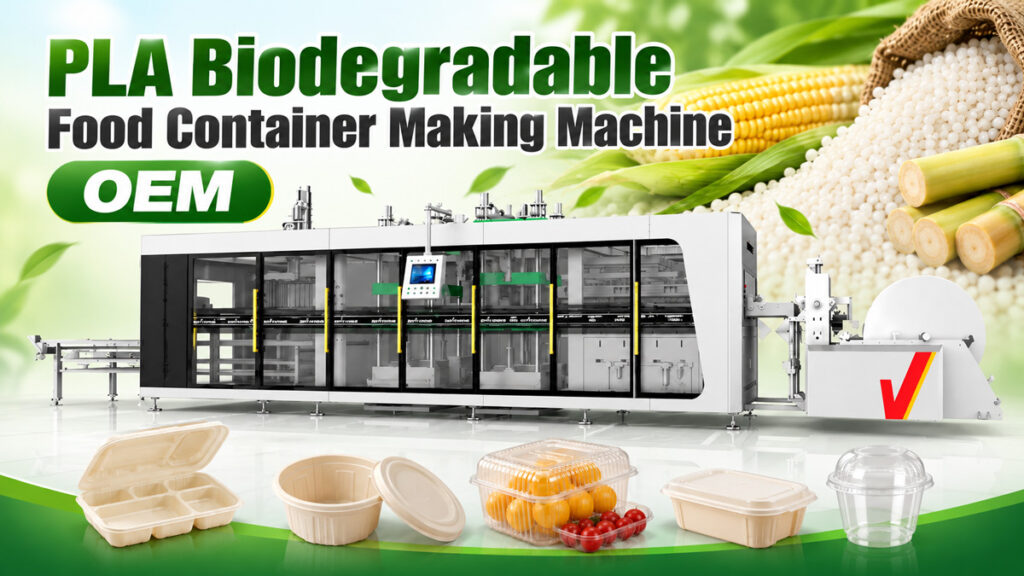
As plastic-restriction policies in the food delivery industry gradually take effect, more and more businesses are switching from traditional plastic containers to biodegradable ones. But how exactly are biodegradable containers made, and what equipment does it take? The answer is a food container making machine — specifically, a positive/negative pressure 3 station thermoforming machine. This article breaks down the production process for biodegradable food containers, what capabilities the equipment needs, and its actual output efficiency.
Common Raw Materials for Biodegradable Containers
Most biodegradable bowls, 5-compartment trays, and 8-compartment trays on the market are made from corn-starch-based PLA sheet, with some manufacturers also using bamboo-powder biodegradable sheet. Both materials can be processed on the same thermoforming equipment, though processing temperature and forming parameters need to be adjusted to match each material’s characteristics.
The Production Process for Biodegradable Food Containers
The production process is similar to that of ordinary plastic containers, running through three continuous steps: heating, positive/negative pressure forming, and punching-and-stacking.
Step 1: Heating and Softening the Sheet
The PLA or bamboo-fiber sheet roll first enters the heating oven, where upper and lower heating elements evenly warm it to softening temperature. PLA is fairly temperature-sensitive, so heating temperature and time need to be controlled more precisely than for standard PET sheet — too hot and the sheet becomes brittle, too cool and forming won’t be complete.
Step 2: Positive/Negative Pressure Mold Closing and Forming
The softened sheet moves to the forming station, where the mold closes from above and below — positive pressure actively pushes from above while vacuum draws from below at the same time — pressing the sheet precisely into the container’s complete shape in one step, including compartment dividers, body contours, and the sealing structure along the lid rim. The rim where the lid closes requires tight dimensional precision, and only the “push-and-pull” action of positive/negative pressure can make the sheet fully conform to every fine mold detail along the edge, ensuring the lid seals tightly without leaking sauce or liquid.
Step 3: Punching, Separation, and Automatic Stacking
The formed containers are still attached to the sheet at this point. The punching station uses a cutting die to precisely separate each individual container, and the separated containers are automatically counted and neatly stacked by the stacking system, moving straight into packaging — with no manual transfer required anywhere in the process.
One Machine Covers Multiple Container Types
A major advantage of the 3-station positive/negative pressure thermoforming machine is that switching to a different mold is all it takes to produce a different container spec, including:
● Biodegradable round bowls: For soup and noodle takeout
●5-compartment trays: Suited for combo meals that need staples and side dishes kept separate
●8-compartment trays: With more compartments, suited for buffet-style or fast-food portioning
Whether it’s corn-starch PLA sheet or bamboo-fiber sheet, and whether it’s a bowl shape or a multi-compartment tray, the machine itself doesn’t need to change — only the forming mold and heating parameters need adjusting, significantly lowering equipment investment for producers running multiple product specs.
Production Efficiency Reference
A well-configured positive/negative pressure 3-station thermoforming machine typically reaches a forming speed of 30-45 cycles per minute (slightly lower than standard PET sheet, since biodegradable materials are more temperature-sensitive). With a multi-cavity mold, hourly output can reach roughly 8,000-15,000 containers, depending on container size and cavity count. The entire process runs fully automated from heating to stacking, and one machine usually only needs a single worker for end-of-line packing — saving most of the labor cost compared to a manual, step-by-step production setup.