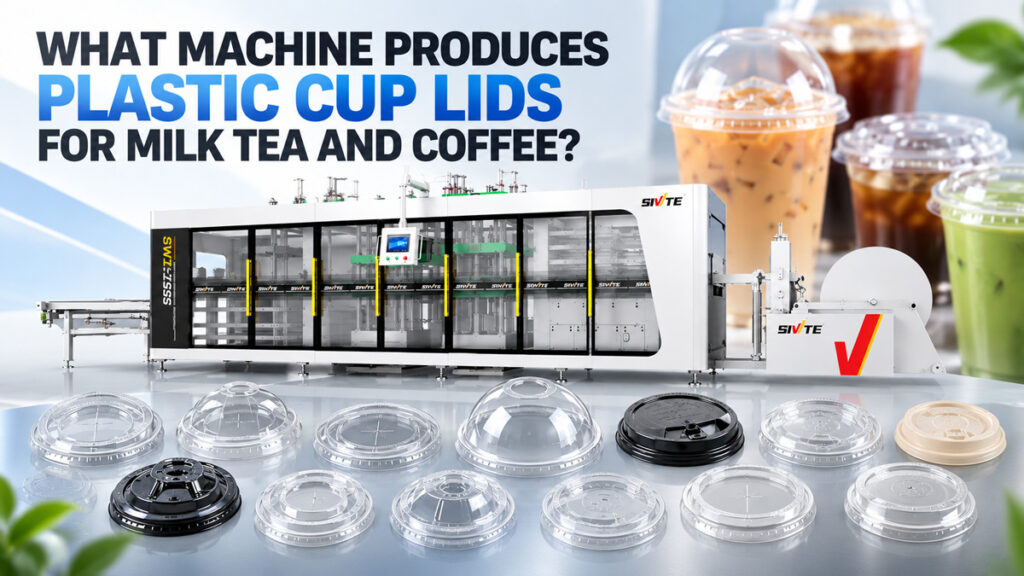
Bubble tea and coffee shops go through an enormous number of plastic lids every day, but few people actually know how these thin, precisely shaped lids get mass produced. The answer is a plastic cup lid thermoforming machine — specifically, a positive/negative pressure three station thermoforming machine. This article walks through the actual production process for cup lids, what capabilities the machine needs, and how the same equipment produces the different lid styles you see on the market.
How Plastic Cup Lids Are Actually Made: The Core Process
Cup lid production is a thermoforming process, typically starting from PET or PP sheet. The whole process runs through three continuous steps: heating, positive/negative pressure forming, and punching-and-stacking.
Step 1: Heating and Softening the Sheet
The rolled sheet first enters the heating oven, where upper and lower heating elements evenly warm it to softening temperature. Even heating directly determines whether the lid’s thickness stays consistent across the whole piece — uneven heating easily causes thin spots or wrinkling.
Step 2: Positive/Negative Pressure Mold Closing and Forming
The softened sheet then moves to the forming station, where the mold closes from above and below — positive pressure actively pushes from above while vacuum draws from below at the same time. This combined force precisely presses the sheet into the lid’s complete shape in a single step, including the snap-fit rim, drinking spout, anti-leak ribs, and even three-dimensional contours on top of the lid. Cup lids are thin-wall, precision products with tight dimensional tolerance on the rim, and only the “push-and-pull” action of positive/negative pressure can make the sheet fully conform to every fine mold detail — which is exactly why lid production depends on this structure rather than vacuum suction alone.
Step 3: Punching, Separation, and Automatic Stacking
The formed lids are still attached to the sheet at this point. The punching station uses a cutting die to precisely separate each individual lid, and the separated lids are automatically counted and neatly stacked by the stacking system, moving straight into packaging — with no manual transfer required anywhere in the process.
The Range of Lid Styles a Positive/Negative Pressure 3-Station Machine Can Produce
By simply swapping the mold, the same positive/negative pressure 3-station thermoforming machine can cover almost every common style of disposable plastic cup lid on the market:
● Flat bubble tea lids: Flat-style lids with a straw hole or letter-shaped opening — currently the highest-demand lid category in the market
● Coffee cup drinking-spout lids: Lids with a raised drinking spout, some also featuring a slidable or removable dust flap
● Dome-shaped (ball-shaped) lids: With a curved, raised top, commonly used for cream-top or fruit tea drinks that need extra headspace
● Flat snap-fit lids: With a rim structure precisely matched to the cup body, sealed by pressing into place — common on cold drink cups
● Lids with carry-handle or multi-cup connector features: Some takeout scenarios use combined lid designs with a built-in handle, which can also be produced on the same machine using a custom mold
Different lid styles vary quite a bit in forming depth and rim detail complexity — dome-shaped lids in particular, with their pronounced raised top, place higher demands on how evenly the positive pressure system applies force. Relying on vacuum suction alone makes it hard to stretch the sheet evenly up into the domed area, often resulting in noticeably thinner wall thickness at the top. This shows that the more varied the lid styles a producer wants to make, the more they depend on true positive/negative pressure forming capability.
Production Efficiency Reference
A well-configured positive/negative pressure 3-station thermoforming machine typically reaches a forming speed of 40-50 cycles per minute. With a multi-cavity mold (say, 8-12 lids per cycle), hourly output can reach roughly 20,000-30,000 lids. The entire process, from heating to stacking, runs fully automated, and one machine usually only needs a single worker for end-of-line packing, keeping labor input very low.