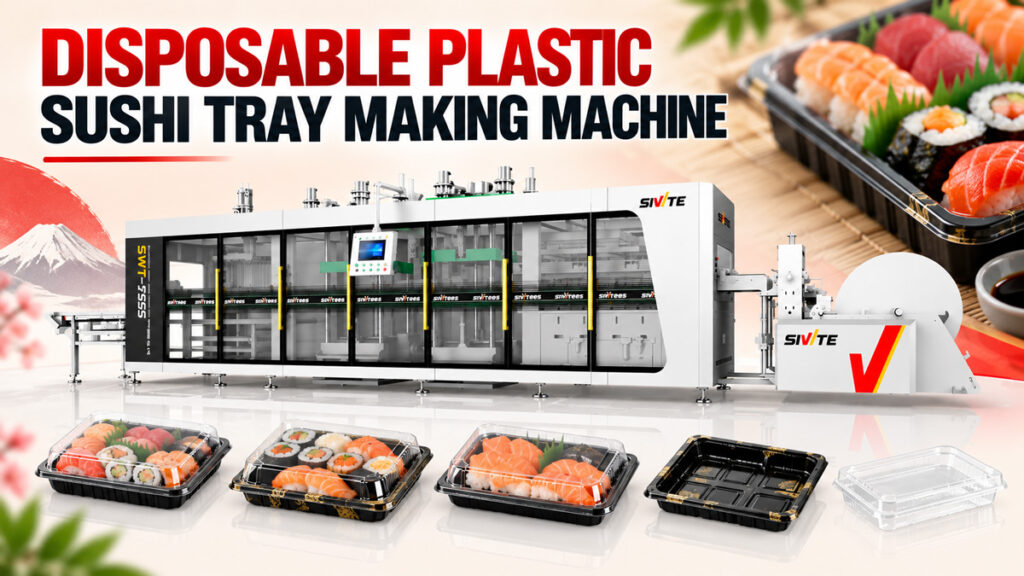
The compartmentalized clear or black sushi trays you see in supermarket refrigerated cases and delivery orders actually demand quite a lot in terms of forming precision and sealing — after all, they’re holding chilled, sauce-containing fresh food. How are these trays produced in bulk? The answer is a sushi tray Making Machine — specifically, a positive/negative pressure 3 station thermoforming machine. This article breaks down the production process for sushi trays, what capabilities the equipment needs, and its actual output efficiency.
Common Raw Material for Sushi Trays
Sushi trays generally aren’t made from general-purpose sheet — they’re produced from specialized sushi tray thermoforming sheet rolls. This type of sheet is typically formulated specifically for refrigerated environments and direct food contact, staying flexible enough at low temperatures to resist becoming brittle and cracking in a cold case, while also meeting clarity or opacity needs (some sushi trays are made in black or dark colors to make the food’s color stand out). Using the right specialized sheet is the baseline requirement for keeping sushi trays performing reliably throughout the cold chain.
The Production Process for Sushi Trays
The production process runs through three continuous steps — heating, positive/negative pressure forming, and punching-and-stacking — with the main forming challenge for sushi trays coming from their multi-compartment dividers and edge-sealing details.
Step 1: Heating and Softening the Specialized Sheet
The specialized sushi tray sheet first enters the heating oven, where upper and lower heating elements evenly warm it to softening temperature. Because sushi trays typically have multiple recessed compartments (to keep different types of sushi separated), uneven heating can leave some compartments incompletely formed, resulting in localized thin walls or poorly defined edges.
Step 2: Positive/Negative Pressure Mold Closing and Forming
The softened sheet moves to the forming station, where the mold closes from above and below — positive pressure actively pushes from above while vacuum draws from below at the same time — evenly stretching the sheet into the tray’s complete cavity structure, with the compartment dividers, rolled rim, and lid-sealing groove all formed in this single step. The sealing edge on a sushi tray needs to match precisely with its clear lid, and the dimensional precision of that sealing groove directly determines whether sauce leaks out once the lid is closed. The corners of multi-compartment dividers also demand even stretching — thin walls at these corners are prone to cracking during refrigeration or transport. The “push-and-pull” action of positive/negative pressure keeps the sheet stretching evenly even across complex, multi-cavity structures, which is exactly what keeps sushi trays leak-free with a secure lid fit.
Step 3: Punching, Separation, and Automatic Stacking
The formed trays are still attached to the sheet at this point. The punching station uses a cutting die to precisely separate each individual tray, and the separated trays are automatically counted and neatly stacked by the stacking system, moving straight into packaging — with no manual transfer required anywhere in the process.
One Machine Produces Sushi Trays Across Multiple Sizes and Styles
The advantage of the 3-station positive/negative pressure thermoforming machine is that switching to a different mold is all it takes to produce different sizes and styles of sushi trays. While there are many sizes and styles on the market, common types include:
Rectangular compartmentalized sushi trays: With multiple elongated dividers inside, used for nigiri and gunkan rolls
Boat-shaped sushi trays: With upturned ends in a boat-like shape, commonly used for mid-to-high-end sushi combo packaging
Round sushi platter trays: Mostly used for family-size or party-sharing packs
Sushi trays with a built-in sauce compartment: A small separate compartment alongside the main cavity for soy sauce or wasabi
Regardless of how size and style vary, the machine itself doesn’t need to be replaced — only the forming mold needs adjusting, substantially lowering equipment investment for producers running multiple sushi tray specs.
Production Efficiency Reference
A well-configured positive/negative pressure 3-station thermoforming machine typically reaches a forming speed of 30-45 cycles per minute when processing specialized sushi tray sheet (slightly slower than simpler thin-wall cup products, given the more complex cavity structure). With a multi-cavity mold, hourly output can reach roughly 6,000-12,000 trays, depending on tray size and cavity count. The entire process runs fully automated from heating to stacking, and one machine usually only needs a single worker for end-of-line packing, significantly reducing labor cost compared to a manual, step-by-step production setup.