If this is your first time getting hands-on with a plastic thermoforming machine — whether looking at equipment drawings or seeing the machine on the shop floor — the sheer number of parts can feel overwhelming. But when broken down by function, a fully automatic 3-station thermoforming machine can actually be organized into about 7-8 core systems, each with a distinct role, working together to carry the entire production process from sheet feeding to finished-product stacking. This article walks through these core components one by one, helping you quickly understand what each part does and how they connect, whether you’re evaluating equipment for purchase or training operators.
Why Understanding Core Components Matters for Both Purchasing and Maintenance
Many buyers focus only on overall output and price when selecting equipment, overlooking the core components themselves. In reality, the machine’s long-term stability, maintenance cost, and troubleshooting efficiency depend heavily on how well you understand what each part does. For example, if sheet thickness turns out uneven in certain spots, knowing that this could relate to the heating system or the cooling system lets you narrow down the cause much faster, instead of assuming the entire machine has failed.
Core Components of a Fully Automatic 3-Station Thermoforming Machine
Feeding System (Unwinding and Sheet Feeding Mechanism)
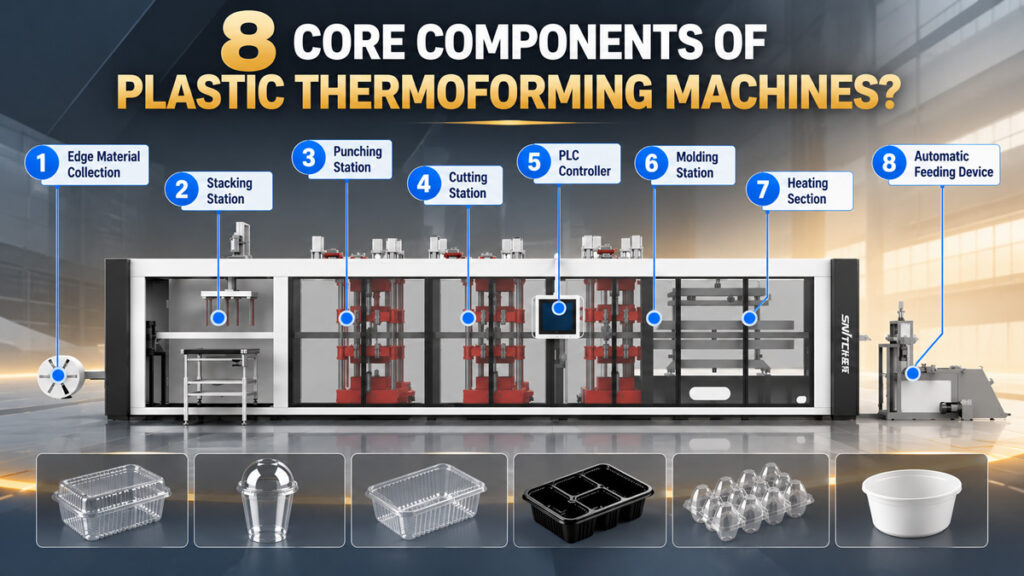
The feeding system unwinds the roll of sheet material smoothly and feeds it into the heating station at a set, consistent pace. This system typically includes an unwind stand, a tension control device, and gripper chains. Tension control precision directly affects how accurately the sheet is positioned during subsequent heating and forming — unstable tension can cause the sheet to drift, leading to misaligned forming downstream.
Heating System (Heating Oven and Heating Elements)
The heating system evenly warms the sheet to the temperature range suited for forming. It typically consists of upper and lower heating ovens, with heating tiles or quartz heating tubes arranged in an array inside. Heating uniformity is the core metric for this system — if one area is underheated, forming quality at that location will suffer, showing up as incomplete forming or abnormal thickness in that spot.
Forming System (Positive/Negative Pressure Mold and Forming Station)
The forming system is the core of a 3-station machine — using the positive/negative pressure system in combination with the mold, it draws or presses the softened sheet into the designed shape. The positive pressure system applies pressure from above, while the negative pressure system draws a vacuum from inside the mold to pull the sheet into shape. Together, they give thin-wall products (like cups and lids) more even wall-thickness distribution and sharper detail forming.
Punching System (Cutting Station and Cutting Die)
The punching system separates the formed products from the sheet, with the cutting die as its core component. The die’s sharpness and cutting precision directly determine how clean the finished product’s edges are — if a worn die isn’t replaced or resharpened in time, it can produce burrs or fail to cut through cleanly (a point we covered in more detail in our earlier article on wear parts).
Stacking System (Automatic Counting and Stacking Mechanism)
Fully automatic machines typically include a stacking system after the punching station, automatically counting finished products to a set quantity and stacking them neatly, reducing manual sorting. Stacking system reliability directly affects downstream packaging efficiency — especially for cups and lids that need to be stacked neatly in bulk, where stacking precision directly impacts packaging speed.
Drive System (Servo Motors and Pneumatic Components)
The drive system provides the power behind every action the machine performs. Fully automatic machines commonly use servo motors, paired with pneumatic components, to handle mold opening/closing, feeding, and other actions. The advantage of servo drives is fast response and high positioning accuracy, allowing the heating, forming, and punching stations to sync their cycle timing more tightly and reduce waiting time between stations.
Control System (PLC and Human-Machine Interface)
The control system is the machine’s “brain,” using a PLC to coordinate the timing of every station’s actions, while operators set temperature, pressure, and cycle parameters through a touchscreen human-machine interface (HMI). A control system with fast response and solid parameter-memory functionality lets the same machine quickly recall preset parameters when switching between products or materials, reducing changeover time.
scrap collection
This is the last workstation of the machine. Its function is very simple, which is to collect the scraps cut off from the cutting station for easy recycling and reuse.
How the Components Work Together: A Full Production Cycle
Take disposable plastic cup production as an example — a full production cycle generally works like this: the feeding system feeds the sheet into the heating oven at a steady pace; the heating system warms the sheet to softening temperature within seconds; the sheet then moves to the forming station, where the positive/negative pressure system and mold complete vacuum forming in 1-2 seconds; the formed sheet moves to the punching station, where the cutting die separates the finished cups; the cut cups are automatically counted and stacked by the stacking system; the entire process is coordinated by the control system, with the cooling system simultaneously setting the product inside the mold.
Based on measured data from our customers, a well-configured 3-station fully automatic thermoforming machine typically completes a full cycle in around 3-5 seconds, with the exact timing depending on product size, sheet thickness, and cavity count. A delay in response from any single core component slows down the overall cycle — which is exactly why understanding each part’s role matters just as much for day-to-day production management as it does for troubleshooting.