
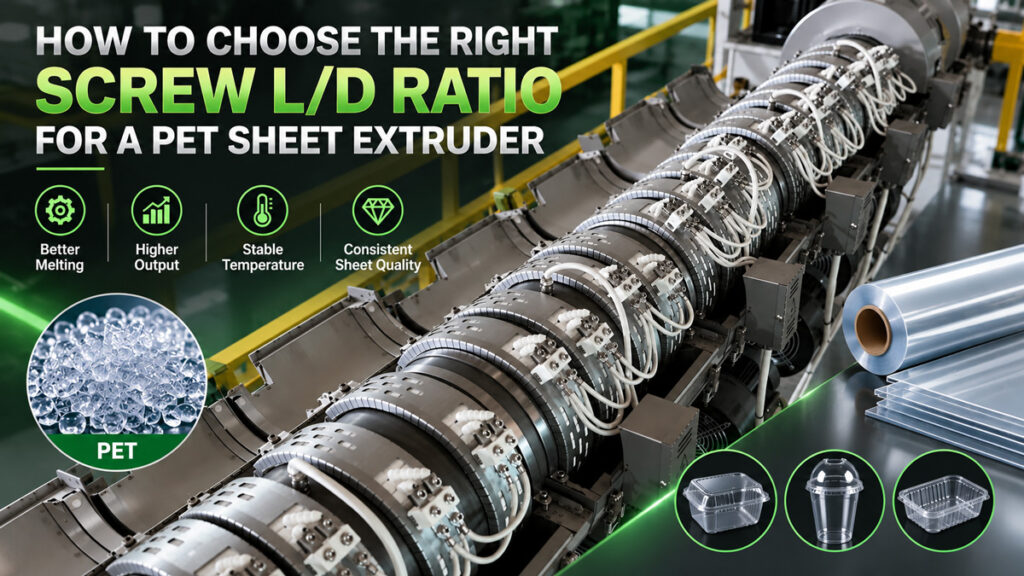
The first time many buyers look at PET sheet extrusion equipment, they notice that different manufacturers’ PET sheet extruders look fairly similar on the outside — the barrel, die, and cooling roller layout all look about the same. But once you look inside at the core component, the PET sheet extrusion screw, you’ll find that even though it’s all “PET sheet,” the screw L/D ratio design is completely different for virgin PET, RPET, CPET, and PETG furniture-mold sheet. This isn’t an arbitrary design choice by manufacturers — it’s because each material has different physical properties, and the extruder must precisely control the temperature profile and material residence time during melt extrusion to avoid crystalline spots, poor toughness, yellowing, and dull surfaces in the finished sheet.
What Is Screw L/D Ratio, and Why Does It Determine Extrusion Quality
Screw L/D ratio refers to the ratio between a screw’s effective working length and its diameter — for example, a screw with a 90mm diameter and 3600mm effective length has an L/D ratio of 40:1. This number might look like a simple geometric parameter, but it directly determines how long the material spends being heated, sheared, and mixed inside the screw, and how many independent temperature-control zones the screw can be divided into — what we commonly call residence time and segmented temperature control precision.
A larger L/D ratio generally allows the screw to be divided into more heating and plasticizing zones, keeping shear intensity and temperature rise in each zone gentler and more controllable. A smaller L/D ratio concentrates plasticization into fewer zones, offering higher efficiency, but if the material is inherently harder to plasticize or carries higher contamination, this can lead to incomplete plasticization or localized over-shearing. This is exactly why screw designs differ noticeably across PET sheet extruders processing different materials — the core goal is using the L/D ratio and segmented temperature-control scheme best matched to each material’s physical properties, controlling plasticization quality and thermal stability at the same time.
What Sheet Defects Result from Poorly Controlled Residence Time
Incomplete Plasticization: Crystalline Spots
If the screw L/D ratio doesn’t match the material’s plasticization difficulty, or the segmented temperature-control design falls short, PET pellets can end up with localized areas that aren’t fully melted during processing. These unmelted particles form visible crystalline spots once the sheet cools — not just an appearance issue, but also a stress concentration point that reduces the sheet’s overall mechanical strength.
Uncontrolled Thermal History: Yellowing, Reduced Toughness, Dull Surface
Conversely, if segmented temperature control and shear intensity aren’t finely tuned to a material’s thermal sensitivity, and material lingers too long or is over-sheared in a localized high-temperature zone, PET undergoes thermal degradation — showing up as yellowing, reduced toughness from molecular chain scission, and a noticeably duller surface. PET is a polyester material that’s fairly sensitive to thermal history, and degradation accelerates significantly with localized dwell above roughly 270°C.
Because these two defect types correspond to opposite problems — “insufficient plasticization” versus “localized thermal history running out of control” — screw L/D ratio and zone design must be precisely matched to each specific material’s melting behavior, rather than reducing the decision to a single dimension like “longer is always safer” or “shorter is always safer.”
SIVITE's Screw L/D Ratio Parameters, Based on Over a Decade of Testing
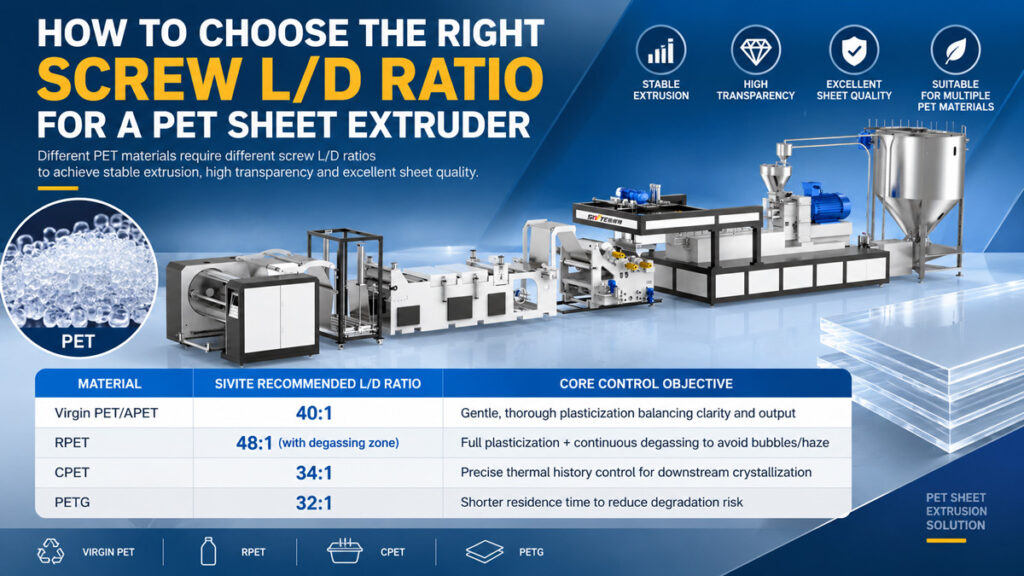
As a manufacturer specializing in PET sheet extrusion screw design, SIVITE sheet extruder manufacturer has spent over a decade running extensive live testing across virgin PET/APET, RPET, CPET, and PETG, gradually arriving at a set of L/D ratio parameters that deliver the most stable sheet quality. These figures aren’t theoretical calculations — they’re the result of repeated validation against real production data:
1. Virgin PET/APET: L/D 40:1
Virgin PET or APET pellets have uniform physical properties and low moisture and contamination levels. SIVITE uses an L/D ratio of 40:1, with more segmented temperature-control zones allowing a gentler, more thorough plasticizing process — maintaining sheet clarity and gloss while delivering stable output.
2. RPET: L/D 48:1 (with Degassing Zone)
Recycled PET (RPET) carries higher moisture, contamination, and IV fluctuation, making plasticization noticeably harder — and it also requires moisture and low-molecular volatiles to be removed during extrusion. SIVITE uses an L/D ratio of 48:1 for RPET, with a dedicated vacuum degassing zone built in, ensuring thorough plasticization while continuously venting volatiles to prevent bubbles and haze defects in the sheet.
3. CPET: L/D 34:1
CPET (crystallized PET) is mainly used for heat-resistant food trays and oven-safe containers. Its distinguishing requirement is that the finished sheet needs a controlled degree of crystallinity to withstand microwave or oven heating. SIVITE uses an L/D ratio of 34:1 for CPET, paired with finer segmented temperature control, so the melt exits the screw in a thermal state suited to the controlled crystallization step that follows — avoiding thermal history that’s either excessive or insufficient for stable crystallization.
4. PETG: L/D 32:1
PETG (glycol-modified PET) has a copolymer unit built into its molecular structure, giving it relatively lower thermal stability, and it’s typically processed at temperatures 20-30°C lower than standard PET — running it for too long easily causes thermal degradation. SIVITE uses an L/D ratio of 32:1 for PETG, pairing a relatively shorter plasticizing travel with lower processing temperatures to keep residence time in high-temperature zones tighter. This parameter was validated and locked in through extensive real-world production data on PETG furniture-mold sheet, reliably lowering thermal degradation risk while still ensuring full plasticization.
The figures above are SIVITE’s recommended parameters, summarized from over a decade of live testing data. Actual L/D ratio should be further fine-tuned based on specific equipment output, raw material IV value, and downstream forming requirements.
Buying Guide: Questions to Ask Before Finalizing a Screw L/D Ratio
● What’s your primary feedstock? Virgin, recycled, or a blend — and at what ratio — since this determines plasticization difficulty and degassing needs
● Do you have plans to produce specialty materials like CPET or PETG? If the same line needs to handle multiple materials in the future, confirm with the manufacturer in advance whether the screw can be modularly adjusted or whether multiple screw sets are needed
● How demanding are your sheet appearance and mechanical property requirements? The higher the requirements for clarity, gloss, and toughness, the more precisely the L/D ratio and segmented temperature control need to be matched