When evaluating a plastic thermoforming machine, vacuum and positive/negative pressure are the two options you can’t avoid comparing. Pricing and specs may look similar, but the suitable use cases differ significantly. This article breaks down the core difference between a vacuum thermoforming machine and a positive/negative pressure thermoforming machine, and the logic behind choosing between them.
The Core Difference: Vacuum Alone vs. Combined Upper/Lower Mold Pressure
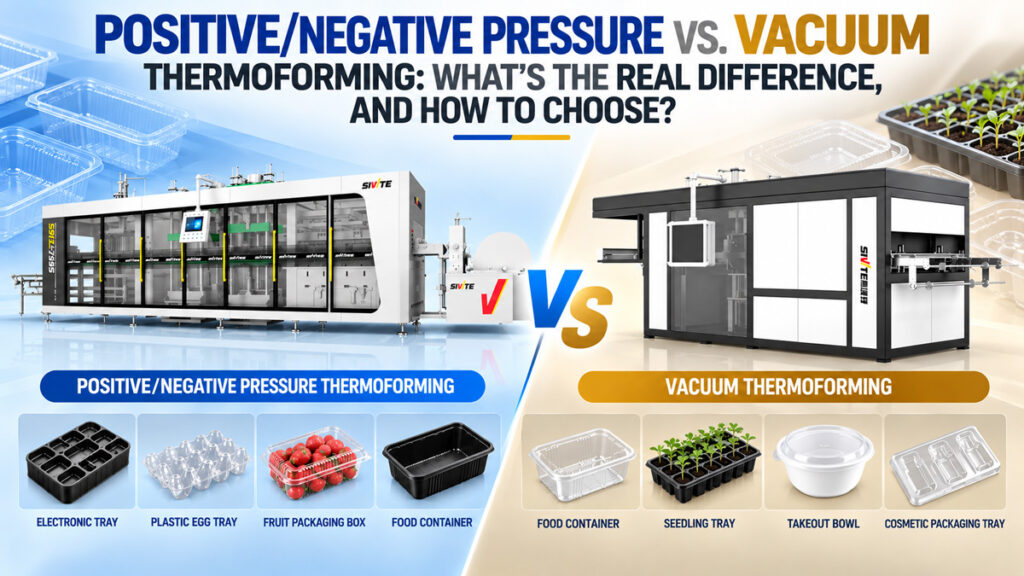
Vacuum forming draws a vacuum below the mold, using pressure difference alone to pull the heated sheet into the cavity. Positive/negative pressure forming closes the mold from above and below — positive pressure actively pushes from above while vacuum pulls from below simultaneously, giving the sheet combined push-and-pull force that conforms to every corner of the mold faster and more completely. The mold also circulates cooling water internally, which speeds up the cycle further.
How to Choose: Matching the Machine to Your Production Needs
1. High-Volume, Long-Term Stable Production with Strict Quality Requirements: Choose Positive/Negative Pressure
Positive/negative pressure machines form with the mold closed from both sides, giving noticeably higher precision, and water-cooled molds keep forming speed fast. This makes them well suited for strict appearance and wall-thickness consistency requirements in long-term, high-volume production — such as cups and lids for food packaging.
| Model | SWT-7585 | SWT-7565 | SWT-6245 |
|---|---|---|---|
| Mould size(max.) | 750*850mm | 750*650(mm) | 620*450(mm) |
| Forming method | Positive And Negative Pressure Forming | ||
| Forming depth(max.) | 140mm | 140mm | 140mm |
| Sheet thickness | 0.16~2.0mm | 0.16~2.0mm | 0.16~2.0mm |
| Forming speed(max.) | 40~50times/min | 40~50times/min | 30~50times/min |
| Air pressure | 0.6~0.8mpa | 0.6~0.8mpa | 0.6~0.8mpa |
| Sheet width(max.) | 410~790mm | 380~760mm | 380~630mm |
| Adaptive material | PET,PP,PS,HIPS,PVC,PLA..... | ||
| Power supply | AC 380V,50Hz,Three-phase,Four-wire (Can be customized according to the power supply voltage requirements of different countries) | ||
| Heatingpower | 117kw | 94.5kw | 91kw |
| Rated power | 153kw | 120kw | 118kw |
| Procedure | Forming-punching hole-cutting-stacking | ||
| Dimension | L*W*H (10.5m*2.15m*2.88m) | L*W*H (9.5m*2.15m*2.8m) | L*W*H (8.0m*2.0m*2.5m) |
| Weight | Around 14T | Around 11T | Around 10T |
2. Small-Batch, Multi-Spec Production: Vacuum Machines Come First
Vacuum machines use a universal mold table that works directly with aluminum, copper, or plaster molds, without needing a custom mold structure for every spec. This still achieves full automation while significantly lowering mold-opening cost, making it well suited for customers running many product specs with smaller batch sizes.
| Forming method | Negative Pressrue Forming | Adaptive material | PET,PP,PS,HIPS,PVC,PLA.... |
|---|---|---|---|
| Mould size(max.) | 760*950mm | Power supply | AC 380V/50Hz(Customizable) |
| Forming depth(max.) | ≤150mm(Customizable) | Heating power | 90Kw |
| Sheet thickness | 0.15~2.0mm | Rated power | 120Kw |
| Forming speed(max.) | 20~40times/min | Procedure | Forming + cutting + stacking |
| Air pressure | 0.6~0.8Mpa | Dimension | L*W*H(10.5m*2.15m*2.8m) |
| Sheet width(max.) | 430~790mm | Weight | Around 11T |
3. Entry-Level, Lower-Requirement Products: High-Speed Servo Thermoforming Machine
High-speed servo thermoforming machines are an older-style design with only a standalone forming station, requiring a separate cutting machine to complete the full production process. Compared to an all-in-one machine, the upfront investment is lower, making it an entry-level option for newcomers — but forming precision is relatively lower, suited only for products with lower requirements.Vacuum machines use a universal mold table that works directly with aluminum, copper, or plaster molds, without needing a custom mold structure for every spec. This still achieves full automation while significantly lowering mold-opening cost, making it well suited for customers running many product specs with smaller batch sizes.
Case Study: Upgrading from a High-Speed Servo Machine Cut Labor Cost by Over 60%
A customer had previously been running production on an SWT-1220 high-speed servo thermoforming machine. Forming precision was low, output couldn’t keep up with demand, and because forming and cutting were separate steps, each machine needed 3-4 workers to keep production running — driving labor costs up significantly.
After upgrading to the SWT-7565 positive/negative pressure thermoforming machine, forming precision improved noticeably, with every product coming out looking sharp, and output doubled. Because forming, punching, and stacking are now fully integrated and automated, each machine only needs one worker for packing, cutting labor cost by over 60%. This case shows that equipment selection shouldn’t be based on upfront cost alone — the long-term difference in output and labor cost is often the deciding factor.