Client: Plastic packaging factory in Phnom Penh, Cambodia
Previous Process: Injection molding, 10–20 seconds/cycle, high mold costs
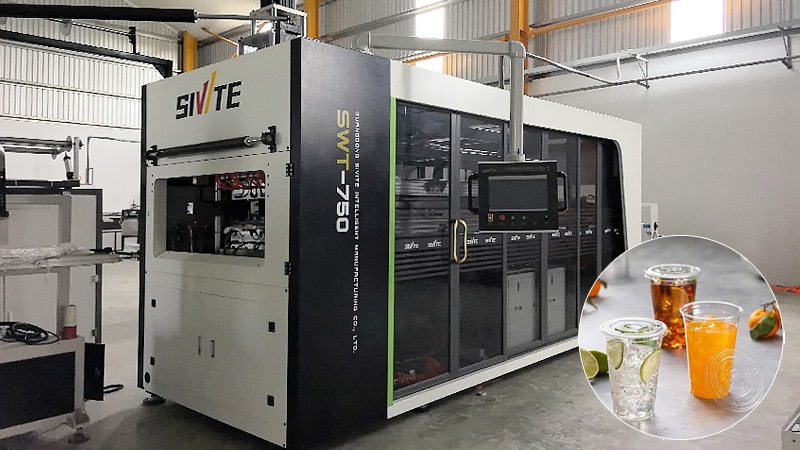
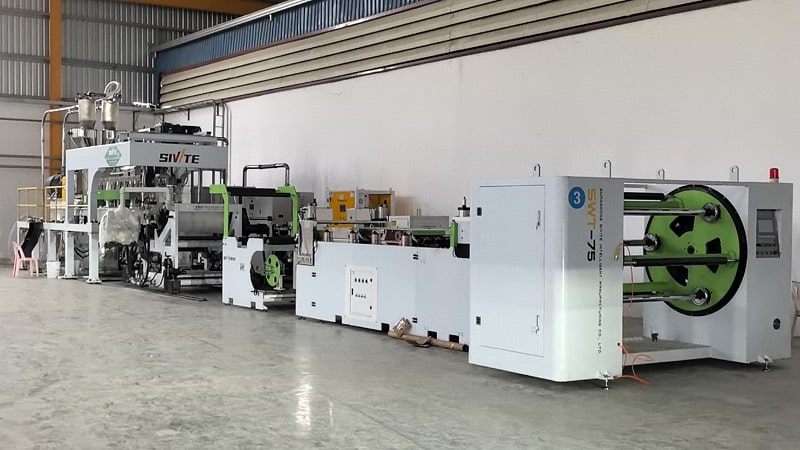
New Solution: 1 SWT-75s PET sheet extrusion line + 2 SWT-750 plastic cup making machines
Key Results:
Production efficiency increased by 50%+
Material costs reduced by 20%
Energy consumption decreased by 15%
Mold cost payback period shortened to just half a month
Labor requirement reduced to 1–2 operators per machine
Challenges faced by the client's factory
A plastic packaging factory in Phnom Penh, Cambodia had been producing plastic cups using injection molding machines for years. They supplied local and regional customers including bubble tea shops, restaurant chains, and food processing companies.
Market pressure was the first red flag. Cambodia’s plastic packaging demand was shifting fast. Customers used to be satisfied with one standard cold cup. Now, their clients — bubble tea brands, fast-food chains — started asking for more sizes, more styles, and faster turnaround. Small-batch, multi-specification orders were becoming the norm, and injection molding simply couldn’t keep up.
Mold cost was the biggest headache. How expensive is an injection mold? Industry data shows injection molds typically cost between $15,000 and $50,000 per cavity, while thermoforming molds are often only 20%–50% of that cost. For this factory, opening a new injection mold meant customers needed two full months just to break even. For small trial orders, the mold cost alone would eat up any profit — and many potential orders were lost right at this stage.
Production cost was spiraling out of control. Raw material price fluctuations, rising electricity tariffs in Cambodia, and increasing labor costs — when these factors combined with the slow cycle times of injection molding, the math stopped working. At 10–20 seconds per cycle, there was only so much output a single machine could deliver. The factory owner put it bluntly: “Some orders, after we subtract material, electricity, and labor, leave us with almost nothing.”
They needed a different approach.
Solutions provided by Sivite
We spent time understanding the factory’s production environment and Cambodia’s local supply chain.
One critical observation stood out: PET sheet is extremely difficult to source locally in Cambodia. Most local packaging factories rely on imported sheet — expensive, long lead times, and inconsistent quality. If we simply supplied a cup making machine, the client would still face the same bottleneck: “machine ready, but no sheet to run.”
That’s why we proposed a complete turnkey solution:
1 SWT-75s PET Sheet Extruder + 2 SWT-750 Cup Making Machines
The logic is straightforward: the client produces their own sheet, then feeds it directly into the thermoforming machines. From raw material formulation to sheet extrusion to cup forming — everything is connected in-house.
Why two cup making machines paired with one extruder? Because the SWT-750 two-station thermoforming machine runs at 3–5 seconds per cycle, compared to injection molding’s 10–20 seconds. A single machine already doubles output. Two machines fully absorb the sheet production capacity while leaving room for future business growth.
Why This Solution Worked
1.Self-Sufficient — and They Can Even Sell Sheet to Others
Once the client started producing their own PET sheet, the biggest change was freedom from imported sheet pricing and delivery uncertainty. Production cost is now predictable and controllable.
But here’s the kicker — the client discovered that surplus sheet could be sold to other local plastic packaging factories in Cambodia. Many of those factories still rely on imported sheet, paying premium prices with long wait times. By becoming a local sheet supplier themselves, the client created an additional revenue stream that further lowers the net cost of sheet used in their own cup production.
2.Capacity Boost — 1.5x to 2x Higher Output
Injection molding: 10–20 seconds/cycle
SWT-750 Thermoforming: 3–5 seconds/cycle
Even at the most conservative estimate, the thermoforming machine runs at more than double the speed. Actual production data shows capacity increased by 1.5 to 2 times. Same orders, shorter production runs, lower per-unit cost.
3.Mold Costs — Drastically Lower
Thermoforming molds are significantly cheaper to manufacture than injection molds — both in material cost and machining complexity. Before the switch, the client hesitated on small-batch, multi-specification orders because each new specification required a new mold, with a break-even period of two months. Small orders couldn’t even cover the mold cost.
Now? Thermoforming molds pay for themselves in just half a month at full load. The client can confidently accept small-batch, multi-specification orders without the fear of losing money on tooling. They’re no longer turning away business.
4.Fully automated production, consistent quality.
Injection molding traditionally requires multiple workers for part removal, trimming, stacking, and other manual tasks. The SWT-750 runs fully automatically. Only 1–2 operators per machine are needed, mainly for packaging and quality checks.
Customer Reviews (Genuine Feedback)
Delivery: Ahead of Schedule
The contracted delivery time was 60 days. We delivered in 50 days — a full 10 days early. For the client, each day saved means earlier production and earlier revenue.
Professional Project Management
Throughout the project, Sivite assigned dedicated personnel for every stage:
Technical consultation
Equipment manufacturing
Factory inspection
Shipping
Installation
Commissioning
After-sales service
The customer appreciated the clear communication and transparent project schedule.
Complete Technical Training
This was the customer’s first experience using thermoforming equipment.
To ensure successful production, Sivite Machinery provided:
Equipment operation training
Mold replacement instruction
Process parameter optimization
Production guidance
On-site commissioning
Operator training
The customer’s technicians quickly became capable of operating the machines independently and later trained additional employees within the factory.
Frequently Asked Questions
Q:Is a plastic cup making machine faster than injection molding?
A:Yes. Thermoforming typically completes one production cycle in 3–5 seconds, while injection molding generally requires 10–20 seconds, depending on the product design and mold configuration.
Q:Can a plastic cup making machine handle small custom orders?
A:Yes. Because thermoforming molds are much less expensive, manufacturers can economically produce multiple cup sizes and small production batches.
Q:Why combine a PET sheet extrusion line with a plastic cup making machine?
A:Producing PET sheet in-house reduces material costs, ensures stable supply, improves quality control, and may even create additional revenue by selling excess sheet to other manufacturers.
Q:How many operators are needed?
A:Most modern automatic production lines require only 1–2 operators, mainly for packaging, quality inspection, and routine machine monitoring.
Q:What support does Sivite Machinery provide?
A:Sivite provides turnkey project planning, equipment manufacturing, installation, commissioning, technical training, process optimization, and long-term after-sales service.