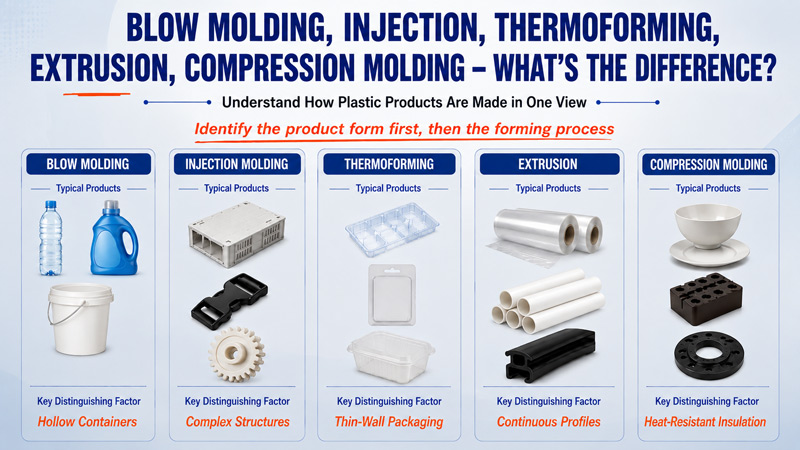
When you pick up a plastic product, the question that comes up again and again — whether you’re a buyer, an engineer, or a factory owner — is simple: how was this actually made? The answer isn’t as complicated as it sounds. Once you understand a product’s physical shape, you can usually work backward to identify the manufacturing process behind it, and from there, the equipment you actually need to buy. This guide breaks down the five most common plastic processing technologies — blow molding, injection molding, thermoforming, extrusion, and compression molding — and offers a practical framework for choosing the right machinery before you spend a single dollar on equipment.
Identify the Manufacturing Process by Product Shape First
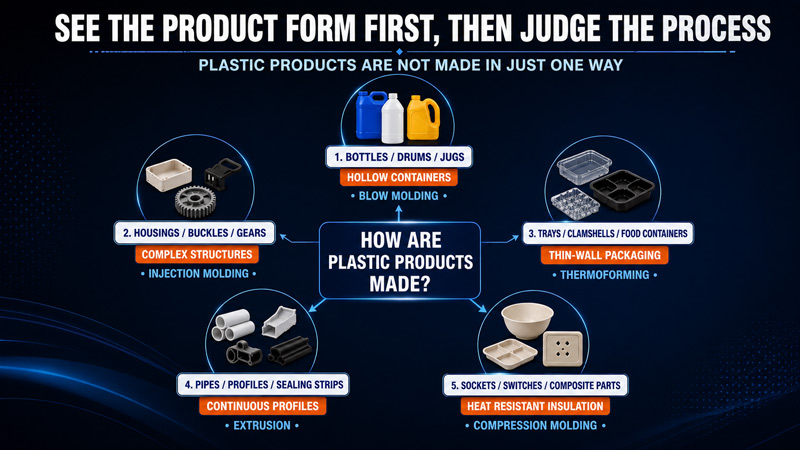
Plastic products are never made using a single universal method. The fastest way to identify the right process is to first classify the product by its physical form:
Plastic products are never made using a single universal method. The fastest way to identify the right process is to first classify the product by its physical form:
Blow Molding:Hollow containers (bottles, drums, jugs)
Injection Molding:Complex structural parts (housings, buckles, gears)
Thermoforming:Thin-wall packaging (trays, blister packs, food containers)
Extrusion:Continuous profiles (pipes, sections, seals)
Compression Molding:Heat-resistant & insulating parts (melamine tableware, bakelite, composites)
This logic works because the underlying physics of each process naturally limits what shapes it can produce efficiently. That’s why the first step in equipment selection is never the price tag — it’s matching the process to the product.
The 5 Major Plastic Processing Technologies Explained
1.Blow Molding — Built for Hollow Containers
Blow molding works by heating a plastic parison until it’s soft, placing it inside a mold, and then inflating it with compressed air so it takes the shape of the mold cavity. Typical products include mineral water bottles, detergent bottles, and plastic drums. A standard extrusion blow molding (EBM) machine producing 500ml beverage bottles usually runs a cycle time of 8–15 seconds per cavity, while large-scale blow molding equipment for industrial drums (around 200L) can take 60–120 seconds per piece. Keyword to identify this process: hollow container.
2.Injection Molding — Built for Complex Structural Parts
Injection molding injects molten plastic under high pressure into a closed mold cavity, then cools and ejects the finished part. It’s one of the most widely used plastic processing methods because it can produce intricate, structurally complex parts — gears, snap-fit buckles, housings — in a single shot. Injection molding machines are classified by clamping tonnage: smaller machines in the 50–200 ton range suit precision electronic enclosures, while machines above 2000 tons are used for large parts like automotive bumpers. Keyword to identify this process: complex structure.
3.Thermoforming (Vacuum Forming) — Built for Thin-Wall Packaging
Thermoforming heats a plastic sheet until it’s pliable, then uses vacuum suction to pull it against a mold surface. It’s the go-to process for food trays, electronics blister packaging, and packaging inserts. Because thermoforming tooling costs are far lower than injection mold tooling, it’s especially well-suited to mid-to-small batch runs with frequent product changeovers — which is exactly why it dominates packaging for consumer goods and electronics. Keyword to identify this process: thin-wall packaging.
4.Extrusion — Built for Continuous Profiles
Extrusion melts plastic resin inside a barrel and continuously forces it through a die with a fixed cross-sectional shape, cooling and cutting the resulting profile to length. The defining trait is a consistent cross-section along the entire length of the product — pipes, structural sections, and door/window seals are the classic examples. A mid-sized PVC pipe extrusion line typically outputs anywhere from a few hundred kilograms to over a ton per hour, depending on pipe diameter and wall thickness. Keyword to identify this process: continuous cross-section.
5.Compression Molding — Built for Heat-Resistant, Insulating Parts
Compression molding places raw material — usually a thermoset resin such as melamine or bakelite powder — into a mold cavity, then applies heat and pressure to cure it into shape. This process is the natural choice for products that need high heat resistance and strong electrical insulation, such as melamine tableware, bakelite electrical sockets, and composite structural parts. Because thermoset materials cure permanently and cannot be remelted, compression-molded parts generally offer better heat resistance and dimensional stability than their injection-molded counterparts. Keyword to identify this process: heat resistance & insulation.
How Should You Actually Choose Your Plastic Processing Equipment?
Match Your Product Type to the Right Process
Identify the product shape first, then the process, and only then the specific machine model. Reversing this order is the most common reason companies end up purchasing equipment that doesn’t actually fit their production needs.