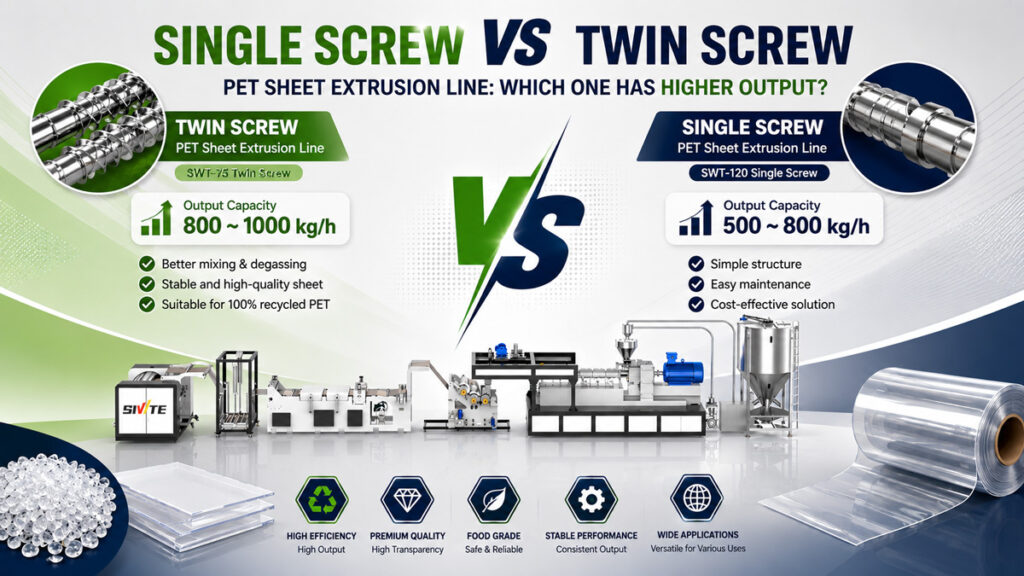
If you’re only processing virgin resin, the output gap between single-screw and twin-screw extruders isn’t actually as large as people assume. But the moment recycled PET enters the mix, the output curves for the two diverge quickly — which is exactly why many factories re-evaluate whether they need a PET Single-Screw Sheet Extruder or a PET Twin-Screw Sheet Extruder when scaling up or switching to recycled material. This article breaks the question down: where the output difference actually comes from, when a single screw is enough, and when a twin screw becomes necessary.
Where the Output Difference Comes From: Structural Principles
To understand the output gap, you first need to understand the fundamental difference in how each screw type conveys and plasticizes the melt.
How Single-Screw Extruders Work
Single-screw extruders rely on friction between the screw and the barrel wall to convey material forward, with plasticization achieved through a combination of shear heat generated by screw rotation and external barrel heating. This design is fairly sensitive to feedstock uniformity — the closer the particle size, density, and melting point are across the batch, the more stable the conveying efficiency. The advantage of single-screw is its simple structure, lower cost, and lower maintenance — and it performs consistently well when processing uniform feedstock like virgin PET or APET pellets.
How Twin-Screw Extruders Work
Twin-screw extruders (co-rotating, intermeshing design as the common example) use two interlocking screws to force material forward. Plasticization doesn’t rely mainly on barrel-wall friction, but on forced shear and mixing between the two screws. This “forced conveying” characteristic gives twin-screw extruders much higher tolerance for variation in feedstock shape, density, and moisture — whether it’s uniform virgin pellets or irregularly shaped, density-inconsistent recycled bottle flake, the conveying speed stays relatively stable.
How Raw Material Type Affects Output: Virgin vs. Recycled
The real variable behind the output gap isn’t the screw itself — it’s how much the feedstock “disrupts” the screw’s conveying efficiency.
Virgin Material Scenario: Single-Screw Is Usually Sufficient
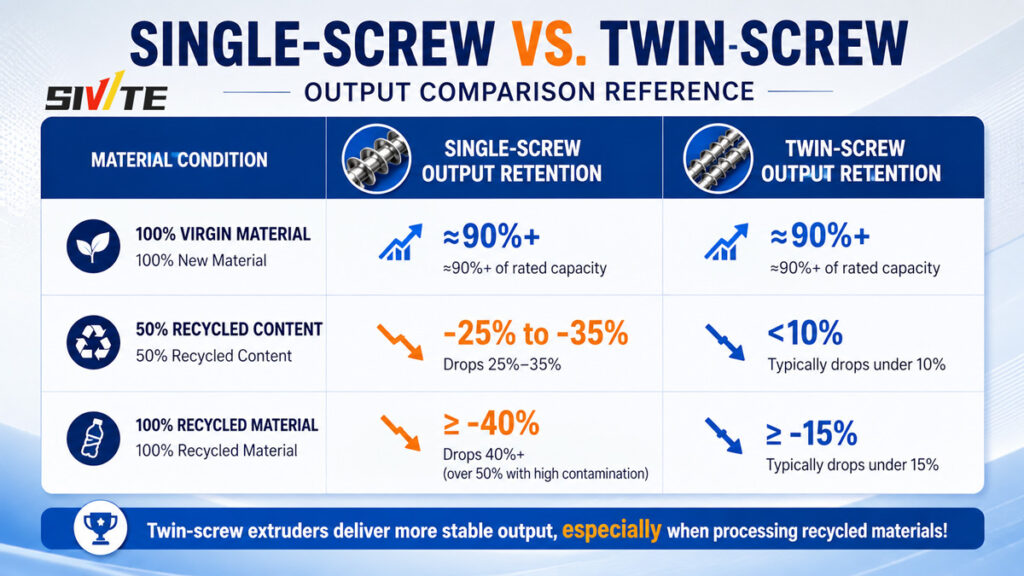
If the feedstock is 100% virgin PET or APET pellets with uniform particle size, consistent density, and controlled moisture, a single-screw extruder can typically maintain output at 90% or more of its rated capacity. In this scenario, single-screw actually offers better value than twin-screw, thanks to lower equipment investment and maintenance costs.
As Recycled Content Increases: Single-Screw Output Drops Noticeably
· Uneven bulk density: Recycled bottle flake typically has a bulk density of only 40%-60% that of virgin pellets. Since single-screw channel volume is fixed, lower density means less actual material weight conveyed per unit time.
· Inconsistent melting behavior: Recycled material often mixes PET from different batches and IV values. The plasticizing zone of a single screw can’t dynamically adjust to this mixed state in real time, which can cause localized under-melting and slow down overall extrusion speed.
· Higher moisture and volatiles: Recycled material generally carries more moisture. Without mid-barrel degassing, single-screw extruders let moisture form bubbles in the melt, forcing operators to reduce screw speed to control the defect — which directly sacrifices output.
Based on measured data from our customers, when recycled content reaches 50%, single-screw output typically drops 25%-35% compared to processing 100% virgin material. When recycled content reaches 100%, the output decline is generally above 40% — and in cases with higher contamination levels, it can exceed 50%.
Twin-screw extruders, thanks to their forced-conveying design and typically integrated multi-stage vacuum degassing, keep the output decline under roughly 15% even when running 100% recycled material — which is why factories processing recycled sheet almost universally lean toward twin-screw configurations.
Single-Screw vs. Twin-Screw Output Comparison Reference
Note that the figures above reflect general industry performance with standard cleaned, crushed bottle flake. Actual numbers will vary based on contamination level, IV value fluctuation, and the equipment’s degassing configuration — always confirm with a trial run using your actual raw material.
Case Study: From an Output Bottleneck to Doubled Production
A customer producing food-grade thermoformed trays had previously used a single-screw line to process a blend of 70% recycled and 30% virgin material, but actual output only reached about 55% of the equipment’s rated capacity, causing ongoing delivery delays. After evaluation, we recommended switching to a twin-screw PET sheet extrusion line configured with two-stage vacuum degassing and an automatic screen-changing filtration system.
After the switch, using the same material blend, actual output reached about 88% of rated capacity — nearly doubling production — while sheet haze and thickness stability also improved noticeably. This case illustrates that if a factory runs high-recycled-content material long-term, the output sacrificed by simply lowering screw speed to accommodate the material actually costs far more than the price difference of a twin-screw machine.
How to Choose: Single-Screw or Twin-Screw
If output alone is the priority, the answer is clear: twin-screw is the safer choice, especially because it isn’t picky about feedstock — whether running virgin or recycled material, it maintains relatively stable, high output. That said, the choice should still be based on your actual production mix:
1. If your feedstock is consistently 100% virgin material year-round, a single-screw extruder remains the more cost-effective choice thanks to lower equipment cost and simpler maintenance
2. If your recycled content regularly exceeds 30%-40%, or you plan to increase it over time, a twin-screw extruder provides much more stable output — and the cost difference typically pays for itself faster than expected
3. If you need one line to flexibly switch between virgin and recycled material, twin-screw offers significantly more tolerance for feedstock variation, reducing downtime spent readjusting after material changes