
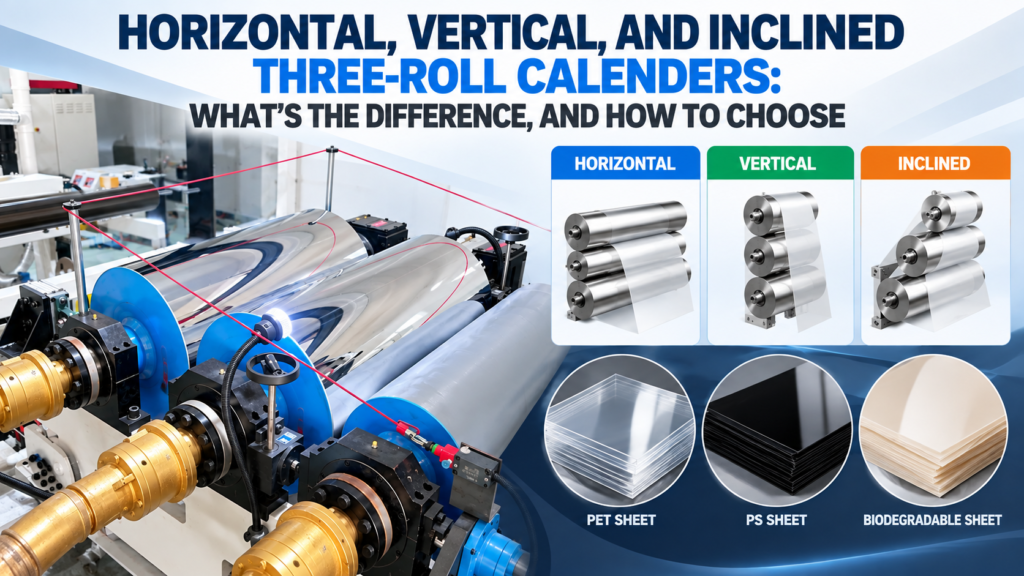
If you’ve paid attention to different manufacturers’ sheet extruder lines, you’ll notice the three cooling-and-calendering rolls aren’t arranged the same way across the board — some sit in a straight horizontal line, some stack vertically, and others sit at an angle. These aren’t just cosmetic differences; when a sheet extruder and three-roll calender work together, the roll arrangement is a structural choice made for specific sheet thickness, material, and output requirements. This article breaks down the differences between horizontal, vertical, and inclined three-roll calender configurations, helping you understand why so many layouts exist and which one fits which production scenario.
What Does a Three-Roll Calender Actually Do?
Before getting into the differences, it’s worth clarifying the role a three-roll calender plays in the sheet extrusion line: melt coming out of the die is soft and unsupported, and needs to pass through three temperature-controlled rolls to be pressed and cooled into a sheet with accurate thickness and surface finish. The three rolls form two nip gaps, and the melt passes through both gaps in sequence to complete initial shaping and cooling — the nip gap spacing directly determines the sheet’s final thickness.
Because melt entry angle into the nip, sheet cooling path length, and available factory floor space all vary, the industry has developed three mainstream layouts over time: horizontal, vertical, and inclined three-roll calenders.
Structural and Functional Differences Between the Three Layouts
1. Horizontal Three-Roll Calender
A horizontal three-roll calender arranges the three rolls in a straight horizontal line, with melt from the die feeding vertically downward into the first nip. This is the simplest structure — operators can perform most adjustment, cleaning, and roll-change tasks from the front of the rolls, giving good visibility and ease of maintenance. Because it’s relatively compact and technologically mature, the horizontal layout is widely used for low-to-medium thickness, general-purpose sheet (such as standard APET or PS sheet for blister packaging), making it one of the most cost-effective options on the market today.
2. Vertical Three-Roll Calender
A vertical three-roll calender stacks the three rolls one above another, with melt entering the nip horizontally from the die while the sheet cools while traveling vertically downward (or upward). The biggest advantage of this layout is its small floor footprint — in facilities with limited horizontal space, a vertical arrangement effectively saves floor area, while the vertical cooling path also gives the sheet more natural cooling time, making it well suited for thin-gauge sheet production where cooling efficiency matters.
3. Inclined Three-Roll Calender
An inclined three-roll calender positions the three rolls at an angle, somewhere between horizontal and vertical. The core advantage of this layout is that it uses gravity to help the melt flow into the nip more naturally — for thicker sheet or higher-viscosity melt (such as PC, ABS, or heavier-gauge PP sheet), the incline helps the melt spread more evenly into the nip, reducing thickness deviation caused by uneven melt buildup. The inclined layout also offers a middle-ground compromise between maintenance accessibility and floor footprint.
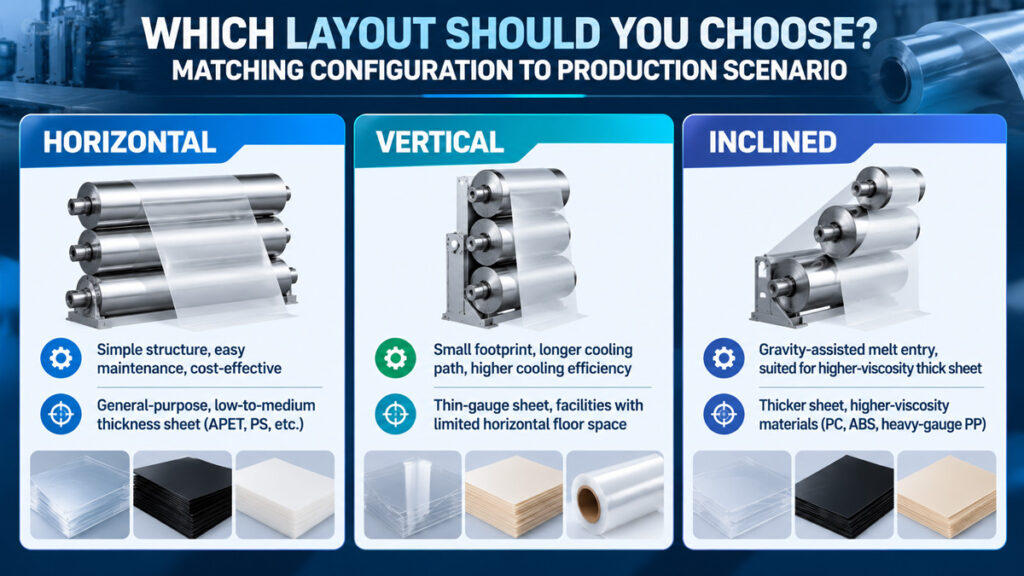
Note that this table reflects general industry tendencies. Actual selection should still factor in real factory floor conditions, target sheet thickness range, and output goals — it’s worth discussing your actual material and thickness requirements directly with the manufacturer during equipment selection.
How Roll Layout Affects Actual Sheet Quality
The choice of roll layout ultimately shows up in two perceptible quality metrics: thickness uniformity and surface finish.
Thickness uniformity mainly depends on whether the melt spreads evenly as it enters the nip — if the melt builds up unevenly or flows inconsistently before reaching the nip, pressure distribution across the nip becomes uneven, causing thickness deviation across the sheet’s width. This is exactly why thicker sheet and higher-viscosity materials tend to favor an inclined layout, since the angle lets gravity help the melt spread more naturally.
Surface finish, meanwhile, depends more on how precisely roll surface temperature is controlled and how long the cooling path is between the rolls. Because the vertical layout offers a relatively longer cooling path, it often achieves better surface gloss and lower haze when producing thin, high-clarity sheet.