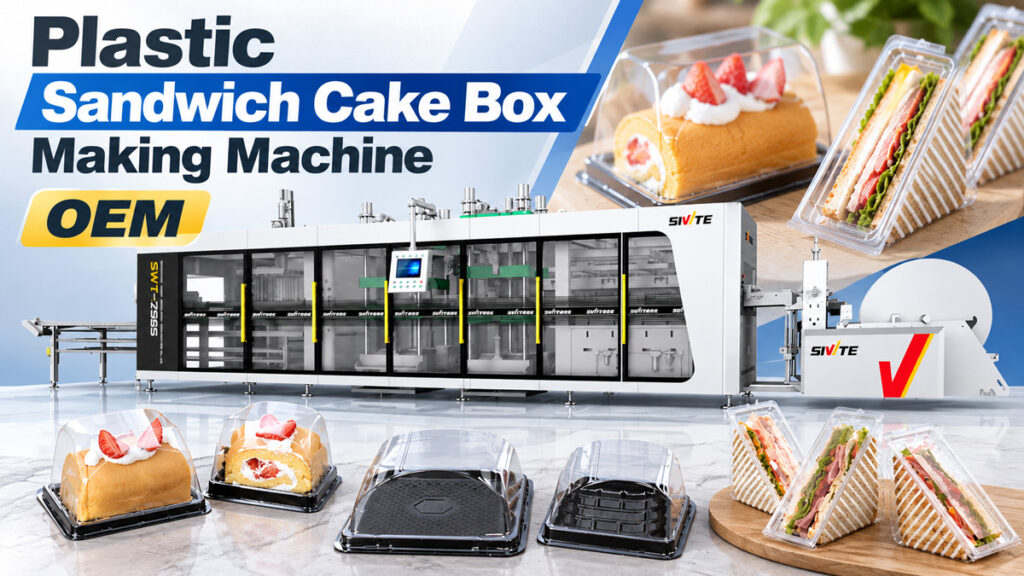
The clear sandwich and cake boxes you see in supermarkets and bakeries look structurally simple, but the requirements for even forming and precise closure are actually quite demanding. How are these packaging boxes produced in bulk? The answer is a Sandwich Cake Box Making Machine — specifically, a positive/negative pressure 3 station thermoforming machine. This article breaks down the production process for sandwich and cake boxes, what capabilities the equipment needs, and its actual output efficiency.
Common Raw Material for Sandwich and Cake Boxes
The mainstream material for sandwich and cake boxes is PET sheet, chosen for its high clarity, solid mechanical strength, and food-grade safety, making it the most common choice for this category of bakery packaging. PET sheet also has fairly balanced stretch performance, which suits sandwich box structures that need a certain forming depth while keeping wall thickness even all around.
The Production Process for Sandwich and Cake Boxes
The production process runs through three continuous steps — heating, positive/negative pressure forming, and punching-and-stacking — with stretch uniformity being the core quality metric for this type of packaging.
Step 1: Heating and Softening the PET Sheet
PET sheet first enters the heating oven, where upper and lower heating elements evenly warm it to softening temperature. Sandwich boxes typically have sloped sides and corner structures, and uneven heating causes localized under-stretching during the forming step that follows, often leading to thin walls or wrinkling at the corners.
Step 2: Positive/Negative Pressure Mold Closing and Forming
The softened sheet moves to the forming station, where the mold closes from above and below — positive pressure actively pushes from above while vacuum draws from below at the same time — evenly stretching the sheet into the box’s complete shape, with the base, sloped side walls, and lid snap-closure edge all formed in this single step. Sandwich boxes rely on a snap-closure edge between lid and base for sealing, and the dimensional precision of that edge directly determines whether the lid stays secure or is difficult to open. The “push-and-pull” action of positive/negative pressure gives the sheet more even force during stretching, resulting in noticeably more consistent wall thickness all around compared to vacuum forming alone — a key factor in ensuring the lid closes smoothly.
Step 3: Punching, Separation, and Automatic Stacking
The formed boxes are still attached to the sheet at this point. The punching station uses a cutting die to precisely separate each individual box, and the separated boxes are automatically counted and neatly stacked by the stacking system, moving straight into packaging — with no manual transfer required anywhere in the process.
One Machine Produces a Range of Bakery Packaging Boxes
The advantage of the 3-station positive/negative pressure thermoforming machine is that switching to a different mold is all it takes to produce different sizes and styles of bakery packaging, covering common use cases:
●Triangular sandwich boxes: The most common spec seen in supermarkets and convenience stores, with an angled shape
●Square and rectangular sandwich boxes: Suited for paninis and wrap-style sandwiches
●Round cake boxes: Clear display packaging for whole small cakes or cake slices
●Tiered cake tray boxes: With internal recessed structures to hold the cake in place and prevent shifting during transport
Regardless of the shape, the machine itself doesn’t need to be replaced — only the forming mold needs adjusting, substantially lowering equipment investment for producers running multiple bakery packaging specs.
Production Efficiency Reference
A well-configured positive/negative pressure 3-station thermoforming machine typically reaches a forming speed of 35-50 cycles per minute when processing PET sandwich and cake boxes. With a multi-cavity mold, hourly output can reach roughly 10,000-18,000 boxes, depending on box size and cavity count. The entire process runs fully automated from heating to stacking, and one machine usually only needs a single worker for end-of-line packing, significantly reducing labor cost compared to a manual, step-by-step production setup.
Case Study: Fixing Uneven Corner Wall Thickness Improved Yield Significantly
A bakery packaging box manufacturer reported that their triangular sandwich boxes frequently had thin wall sections at the angled corners. After being filled and transported, the corners were often the first spot to crack, leading to a fairly high customer complaint rate and a scrap rate that stayed around 8% long-term.
After evaluation, we recommended switching to a positive/negative pressure 3-station thermoforming machine, along with an optimized mold structure at the corner areas. After the upgrade, the sheet received more even force during stretching, corner wall-thickness consistency improved noticeably, and the scrap rate dropped from around 8% to under 2%, with customer complaints essentially disappearing. This case shows that even though sandwich and cake boxes look structurally simple, stretch uniformity directly affects how the product actually holds up during transport.