

For global packaging manufacturers, selecting the right plastic thermoforming mold is just as critical as choosing the forming machine itself. The mold comes into direct contact with the heated plastic sheet, determining the product’s surface finish, dimensional tolerances, cycle times, and overall service life.
Let’s take a detailed look at everything you need to know about plastic thermoforming molds—including mold types, how to match them with different machines, and which materials best suit your production needs.
What materials are thermoforming molds made of?
Selecting mold materials is a fascinating topic. Different materials are suited to varying production scales, precision requirements, and budgets. Below are the three most common types of molds you will encounter:
1. Aluminum Molds — Industry Standard
Aluminum molds have become the material of choice for professional thermoforming operations. They offer rapid forming capabilities, high precision, and a long service life—all of which contribute to stable, consistent production. The reasons for the dominance of aluminum molds include:
Durability: Aluminum molds can withstand over 100,000 forming cycles, making them ideal for mass production.
Precision: Aluminum can be CNC-machined to achieve exceptional dimensional accuracy and surface finishes as fine as Ra ≤ 0.2μm (mirror-like finish), making it perfect for manufacturing transparent products such as food containers.
2. Electroplated Copper Molds—A Mid-Range Choice
The production of copper molds begins with a plaster master mold, onto which a layer of copper is electroplated. This process enhances surface strength and improves wear resistance.
Key features:
Cost: Moderate (lower than aluminum molds, higher than plaster molds)
Production lead time: Typically 5–7 days per mold
Service life: Approximately 100,000 units
Surface quality: Good, though precision is lower than that of aluminum molds
Suitable applications: Medium-scale production—situations where expensive aluminum molds are not justified, yet plaster molds cannot meet durability requirements.
3. Plaster molds—generally used only for prototyping.
Gypsum molds are produced by mixing gypsum powder with water and pouring the mixture into a mold frame. They harden through a dehydration process and can be shaped and finished by hand.
Key Characteristics:
Cost: Very low
Production cycle: 1–3 days (fastest)
Service life: Very short—limited to a few hundred molding cycles at most
Precision: Rough surface finish; dimensional deviation is approximately ±2 mm relative to the nominal design values
Applications: Prototyping and sample validation—not suitable for mass production
The primary limitation of gypsum molds is their fragility. Under high-temperature operating conditions, the mold surface may become rough, deform, or even crack. Gypsum molds often struggle to achieve ideal results for products with complex geometries or those requiring deep-draw forming.
How Machine Type Affects Mold Selection
Different thermoforming machines place different demands on molds. Let’s break it down by machine type.
1.3-Station and 4-Station Positive and Negative Pressure Thermoforming Machines
These are the most advanced machines in the market. They combine vacuum suction (negative pressure) with positive air pressure to form complex geometries with excellent wall thickness control.
Mold requirements for positive-negative pressure machines:
High clamping forces: The combination of positive and negative pressure exerts more force on the mold. Aluminum molds are strongly recommended over copper or plaster, which may deform under pressure.
Extended service life: These machines typically run at 25-50+ cycles per minute, 24/7. Mold life directly impacts production uptime. Aluminum alloys (like T6-treated aluminum) can handle over 1 million cycles with proper maintenance.
Surface finish requirements: Positive-negative pressure forming can achieve finer details than vacuum-only. Aluminum’s machinability allows for mirror finishes and intricate surface textures that other materials can’t match.
Precision fit: These machines often use independent mold stations (forming, cutting, punching) with synchronization accuracy as tight as ±0.02mm. Aluminum molds can be machined to these tolerances; copper and plaster cannot.
2.Multi-Station Negative Pressure (Vacuum) Thermoforming Machines
Compared to positive-and-negative pressure models, this multi-station negative-pressure thermoforming machine also features a fully automated, integrated multi-station design. However, its forming process—utilizing negative-pressure vacuum forming—mirrors that of high-speed servo machines, offering greater versatility in mold selection; it is compatible with virtually any mold type, including copper, aluminum, and plaster molds. It is particularly well-suited for orders involving diverse product specifications and small batch sizes, as it entails lower mold-making costs while delivering high output and labor savings comparable to positive-and-negative pressure models.
3.Single-Station High-Speed Thermoforming Machines
Single-station machines are simpler and more flexible. The sheet is clamped along all four edges, heated, formed, and removed at the same location.
Mold requirements for single-station machines:
Lower pressure requirements: Since single-station machines typically use vacuum-only forming, molds don’t need to withstand high positive pressures. This means plaster and wood molds can be used for prototyping on these machines.
Flexible material choices: Single-station machines can handle any moldable thermoplastics material, making them ideal for short-run production where aluminum molds may not be cost-effective.
Lower mold cost per unit: The slower cycle speed (typically 10-40 cycles per minute) means molds experience less wear per shift, so you can potentially use less expensive materials for lower-volume runs.
How to Choose the Right Plastic Thermoforming Machine Mold
Here’s a decision framework to guide your selection:
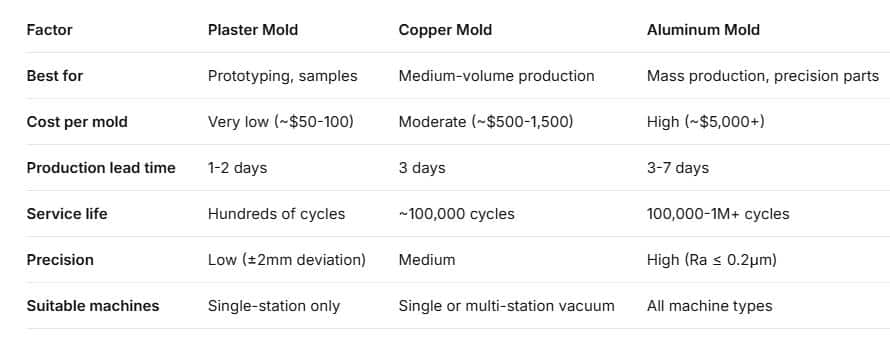
Recommendations from the manufacturer
Many new clients have successfully used this approach to reduce the prototype scrap rate from 15% to 5% and cut the per-unit cost by 15%. Only after completing product validation did the company switch to aluminum molds, thereby reducing the share of total mold costs from 18% to 9%.