
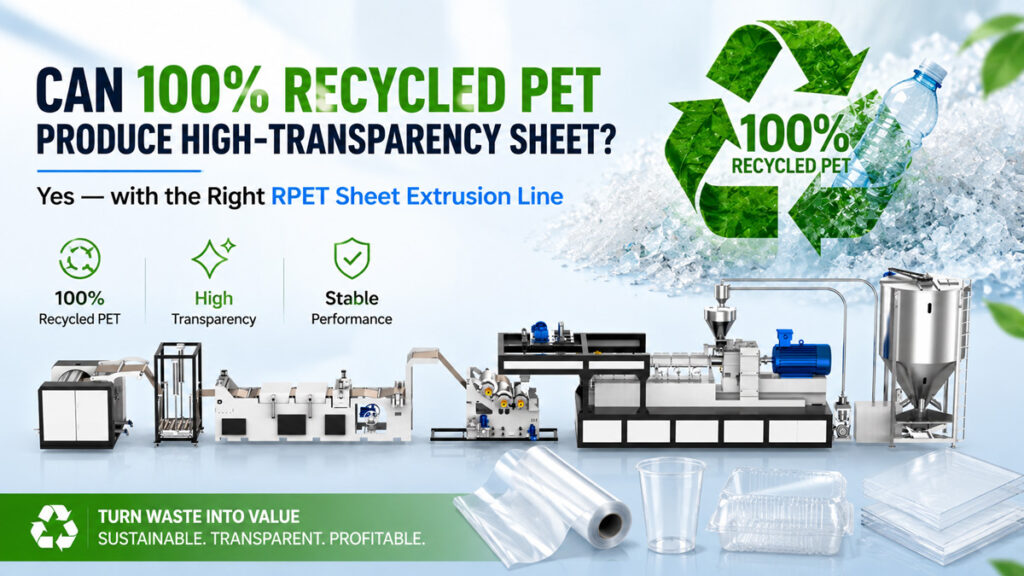
The answer is yes — but only with the right equipment. When manufacturers first try producing sheet from 100% recycled PET (RPET), the biggest obstacle usually isn’t cost, it’s transparency: sheets turn yellowish, show black specks, or have excessive haze that fails blister-packaging or cup-forming appearance standards. In most cases, the problem isn’t the raw material itself — it’s that the RPET sheet extrusion equipment hasn’t been configured for the specific characteristics of recycled resin.
This article breaks down the technical challenges of processing 100% recycled PET into clear sheet, and explains why a twin-screw RPET sheet extrusion line is widely considered the more reliable solution in the industry today.
Three Core Challenges in Processing 100% Recycled PET
Recycled PET — whether bottle flake or recycled pellets — differs fundamentally from virgin resin in both structure and purity, and this directly affects the transparency of the final sheet.
1.Contaminants and Off-Color Particles
Recycled resin inevitably contains contaminants such as PVC, label residue, and adhesive traces. Even at just 0.1%-0.3% concentration, these can create visible black specks or discoloration on the sheet, directly downgrading the appearance quality of thermoformed products.
2.Unstable Intrinsic Viscosity (IV Value)
Virgin PET generally has a consistent IV value, but recycled resin can vary by batch, with IV fluctuations of 0.05-0.10 dL/g. This instability causes melt flow to swing, leading to variation in sheet thickness and clarity — and in severe cases, localized crystallization that appears as white haze.
3.Moisture and Volatile Low-Molecular Compounds
Recycled bottle flake readily absorbs moisture during washing and crushing, and PET that has undergone repeated thermal cycles generates more low-molecular-weight degradation byproducts. If these volatile compounds aren’t properly removed during extrusion, they form bubbles and hazy defects inside the sheet.
Because none of these three issues can be solved simply by upgrading raw material grade, the extruder’s mixing capability, filtration precision, and degassing efficiency become the key variables that determine sheet transparency.
Why Equipment Selection Determines RPET Sheet Transparency
Single Screw vs. Twin Screw: The Real Difference When Processing Recycled Resin
Single-screw extruders are simple and cost-effective, well-suited for consistent feedstock like virgin PET or APET pellets. But with complex recycled resin, single-screw shear and mixing intensity is limited — it struggles to disperse contaminants evenly and can’t fully degas low-molecular-weight volatiles.
Twin-screw extruders (co-rotating, intermeshing design) offer clear advantages here:
The intermeshing screw design delivers stronger shear and dispersive mixing, breaking down fine contaminants and color specks to a level that no longer affects appearance
Multi-stage vacuum degassing continuously removes moisture and low-molecular volatiles during melt processing — something single-screw designs struggle to achieve
Controlled residence time prevents PET from thermally degrading and yellowing due to prolonged exposure to high heat inside the barrel
Based on measured data from several of our recycled-material processing clients, the same batch of bottle flake with an IV of 0.68-0.72 dL/g typically produces sheet with 3%-5% haze on a twin-screw line, while the identical batch processed on a single-screw line often shows haze above 8% — a light-transmission gap of roughly 10 percentage points.
Filtration System Matters Just as Much
Beyond screw design, melt filtration precision directly determines sheet cleanliness. For a 100%-recycled-material line, we recommend at minimum a dual-piston automatic screen changer with 40-60 micron filtration precision, allowing continuous contaminant removal without stopping production — keeping sheet quality consistent throughout the run.
SWT Twin-Screw RPET Sheet Extrusion Line — Core Specifications
Different output requirements call for different screw sizes. Below are the specifications for the three main models in the SWT series’ modular (“building block”) twin-screw configuration, which can be selected based on actual capacity needs and sheet specifications:
| Model | Adaptive material | Screw form | Specifications(mm) | Sheet thickness(mm) | Sheet width(mm) | Extrusion volume |
|---|---|---|---|---|---|---|
| SWT-75S | PET,PP,PS,PLA... | Building Block Type | φ75 | 0.2~2.0 (mm) | ≤800(mm) | 450~650(kg/h) |
| SWT-85S | PET,PP,PS,PLA... | φ85 | 0.2~2.0 (mm) | ≤1000(mm) | 600~900(kg/h) | |
| SWT-95S | PET,PP,PS,PLA... | φ95 | 0.2~2.0 (mm) | ≤950(mm) | 800~1200(kg/h) | |
The advantage of a modular (“building block”) twin-screw design is that screw elements can be flexibly combined based on the recycled resin’s contamination level and IV fluctuation, allowing targeted adjustment of the dispersion and degassing zone ratio. This is why recycled-material processors tend to favor modular screw designs over fixed configurations when selecting equipment.
For small-to-mid volume producers focused mainly on blister packaging, the SWT-75S’s 400-600 kg/h output is usually sufficient for single-shift production
For higher-volume needs or facilities feeding multiple downstream forming lines, the SWT-85S or SWT-95S can be considered, with output up to 1300 kg/h
All three models cover the same sheet thickness range (0.15-2.0mm), allowing flexible thickness adjustment across different downstream forming processes such as blister packaging and cup thermoforming
Case Study: From 12% Haze to Meeting Transparency Standards
A food blister-packaging customer had previously used a single-screw line to process mixed recycled material, with product haze consistently fluctuating between 10%-12% and a relatively high complaint rate. After evaluating their raw material sourcing and equipment configuration, we recommended switching to a twin-screw RPET sheet extrusion line and adjusted the degassing stage configuration and filtration precision.
After the upgrade, the same batch of recycled material (100% crushed bottle flake, no virgin resin blend) produced sheet with haze stable at around 4%, light transmission above 90%, meeting the appearance standard for blister-grade transparent packaging — while the customer’s raw material cost dropped roughly 30% compared to using virgin PET.
This case illustrates that whether 100% recycled material can produce transparent sheet largely depends on whether the equipment is designed to handle the resin’s contamination, viscosity fluctuation, and volatile characteristics — not simply on whether the raw material is “good” or “bad.”
Key Considerations When Selecting an RPET Sheet Extrusion Line
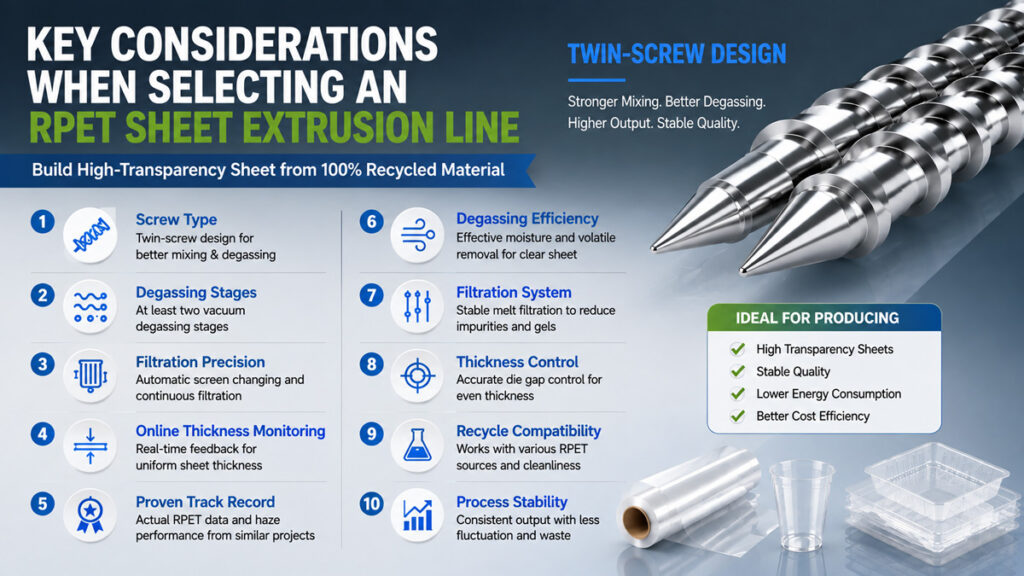
If you’re evaluating a line for producing transparent sheet from 100% recycled material, focus on the following:
Screw type: Is it a twin-screw design capable of sufficient dispersive mixing and degassing?
Number of degassing stages: At least two vacuum degassing stages, adjustable based on raw material moisture content
Filtration precision: Does it support automatic screen changing and continuous filtration to avoid frequent downtime?
Online thickness monitoring: Can it provide real-time feedback to adjust die gap and maintain uniform sheet thickness?
Proven track record with recycled material: Can the manufacturer provide actual haze and transmission data from similar feedstock?
When selecting equipment, it’s worth asking the supplier to run trial tests using your own recycled material — actual haze and transmission data is more convincing than any spec sheet.
Conclusion
100% recycled PET can absolutely produce transparent sheet suitable for blister packaging and cup thermoforming. The key isn’t the raw material itself, but whether the extrusion equipment is designed to handle contaminant dispersion, viscosity fluctuation, and degassing requirements of recycled resin. The advantages of a twin-screw RPET sheet extrusion line in mixing intensity, degassing efficiency, and filtration precision make it the mainstream solution for stable, large-scale production of transparent recycled sheet today.