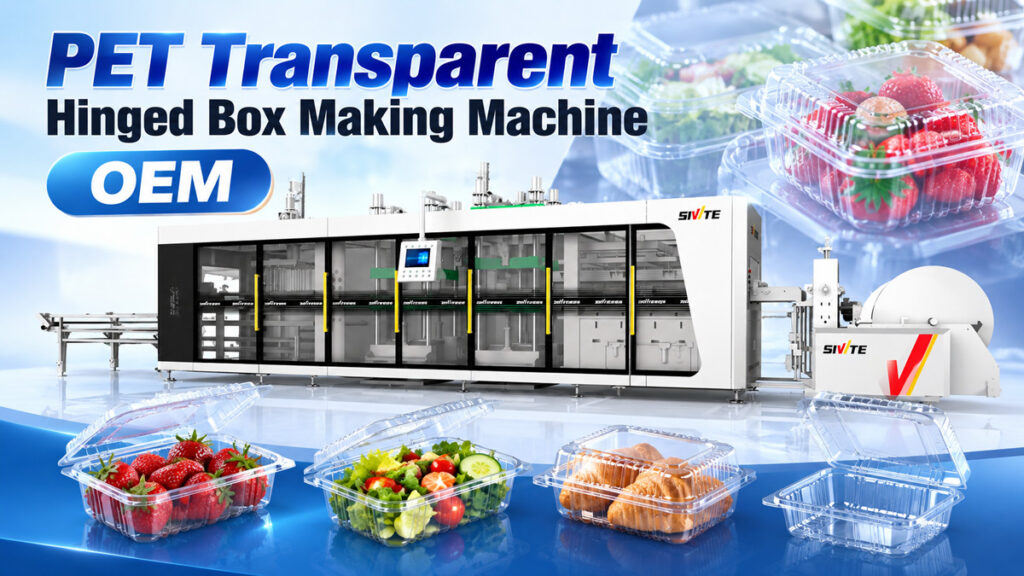
The clear, flip-top packaging boxes you see for fruit and bakery items have a proper name — hinged boxes — known for high clarity and a lid that stays connected to the base, opening and closing by folding along a hinge. How are these produced in bulk? The answer is a Hinged Box making Machine — specifically, a positive/negative pressure 3 station thermoforming machine. This article breaks down the production process for transparent hinged boxes, what capabilities the equipment needs, and its actual output efficiency.
Common Raw Materials for Hinged Boxes
Most transparent hinged boxes on the market are made from PET sheet, prized for its high clarity and solid mechanical strength, making it the most common choice for fruit and cake boxes. Some manufacturers also use high-clarity PP sheet, which handles cold temperatures better, suited for boxes that need to withstand refrigerated display. Both materials can be processed on the same machine, with only heating temperature and forming parameters needing adjustment.
The Production Process for Transparent Hinged Boxes
The production process also runs through three continuous steps — heating, positive/negative pressure forming, and punching-and-stacking — but hinged boxes demand more precise forming detail than ordinary containers, especially at the hinge fold and snap-closure structure.
Step 1: Heating and Softening the Sheet
PET or high-clarity PP sheet first enters the heating oven, where upper and lower heating elements evenly warm it to softening temperature. Because hinged boxes require extremely high clarity, heating uniformity directly determines whether water-ripple marks appear after forming — a wavy optical defect caused by uneven localized heating. Areas that heat unevenly show noticeably reduced light transmission once cooled, directly downgrading the product’s appearance grade.
Step 2: Positive/Negative Pressure Mold Closing and Forming
The softened sheet moves to the forming station, where the mold closes from above and below — positive pressure actively pushes from above while vacuum draws from below at the same time — pressing the sheet into the complete one-piece structure of base, hinge fold line, and lid. Sheet thickness at the hinge fold must be even and flexible enough to withstand repeated opening and closing without cracking, and the snap-closure edge between lid and base needs strict dimensional precision to stay securely closed without loosening. Only the “push-and-pull” action of positive/negative pressure can stretch the sheet fully into these fine hinge details, avoiding the localized thinning that leads to hinge failure.
Step 3: Punching, Separation, and Automatic Stacking
The formed hinged boxes are still attached to the sheet at this point. The punching station uses a cutting die to precisely separate each individual box while preserving the integrity of the hinge fold line, and the separated boxes are automatically counted and neatly stacked by the stacking system, moving straight into packaging — with no manual transfer required anywhere in the process.
One Machine Produces a Wide Range of Flip-Top Packaging Boxes
The advantage of the 3-station positive/negative pressure thermoforming machine is that switching to a different mold is all it takes to produce hinged boxes of different sizes and purposes, covering the range of packaging needs common in the fruit and food industry:
● Single-serving fruit hinged boxes: Clear display packaging for individual portions of berries and small fruit
● Multi-compartment hinged boxes: With internal dividers, used for mixed fruit packs or fruit platters paired with dipping sauce
● Cake and bakery hinged boxes: Deeper box body with internal support ribs, preventing food from shifting during transport
● Salad and light-meal hinged boxes: With a flat, wide lid, sized to fit utensils alongside the food
Regardless of how the product application changes, the machine itself doesn’t need to be replaced — only the forming mold and heating parameters need adjusting, substantially lowering equipment investment for producers running multiple packaging specs.
Production Efficiency Reference
A well-configured positive/negative pressure 3-station thermoforming machine typically reaches a forming speed of 35-50 cycles per minute when processing PET or high-clarity PP hinged boxes. With a multi-cavity mold, hourly output can reach roughly 10,000-20,000 boxes, depending on box size and cavity count. The entire process runs fully automated from heating to stacking, and one machine usually only needs a single worker for end-of-line packing, significantly reducing labor cost compared to a manual, step-by-step production setup.