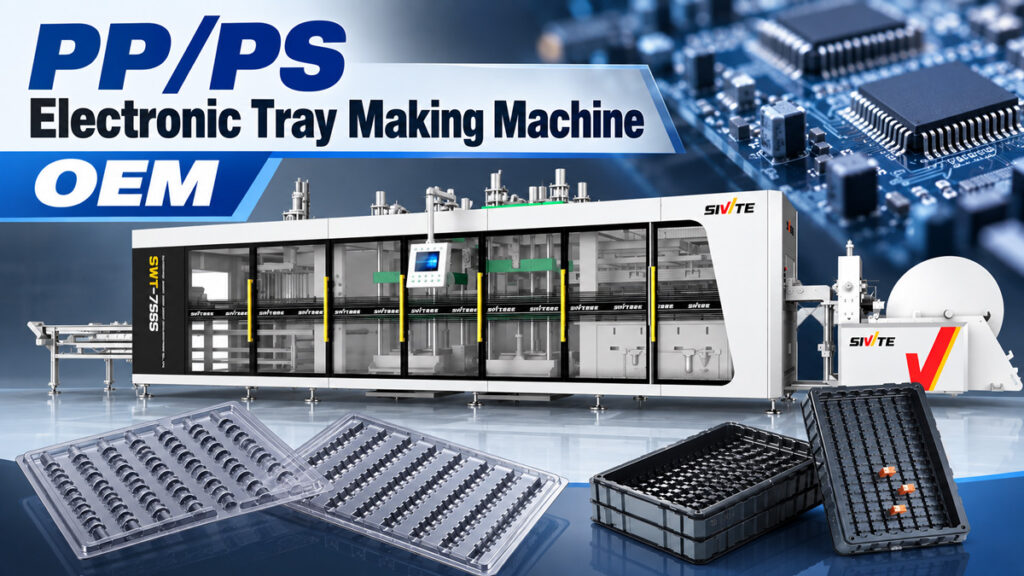
Electronic components rely heavily on antistatic trays for transport and storage, and these trays demand much stricter forming precision and edge quality than ordinary packaging. How exactly are electronic trays produced? The answer is an electronic tray making machine oem — specifically, a positive/negative pressure 3 station thermoforming machine. This article breaks down the production process for electronic trays, what capabilities the equipment needs, and its actual output efficiency.
Common Raw Materials for Electronic Trays
Electronic trays commonly use three materials — PET, PP, and PS — with PS (antistatic-modified polystyrene) being the most widely used, thanks to its good rigidity, high forming precision, and relatively controllable cost, making it the mainstream choice for antistatic trays in the electronics industry. PET and PP are used more often when extra heat resistance or clarity is needed. All three materials can be processed on the same machine, with only heating temperature and forming parameters requiring adjustment.
The Production Process for Electronic Trays
The production process also runs through three continuous steps — heating, positive/negative pressure forming, and punching-and-stacking — but electronic trays demand notably higher edge-cutting quality than ordinary packaging boxes.
Step 1: Heating and Softening the Sheet
PET, PP, or PS sheet first enters the heating oven, where upper and lower heating elements evenly warm it to softening temperature. PS material is relatively more brittle, so heating temperature and time need to be finely controlled — insufficient heating leaves localized stress concentration in the formed sheet, setting up the risk of cracking during the cutting step that follows.
Step 2: Positive/Negative Pressure Mold Closing and Forming
The softened sheet moves to the forming station, where the mold closes from above and below — positive pressure actively pushes from above while vacuum draws from below at the same time — precisely pressing the sheet into the tray’s cavity structure, with the size, depth, and spacing of each component slot all formed in this single step. Slot dimensional precision directly affects whether components shift or knock against each other during transport, and positive/negative pressure forming lets the sheet conform more fully to these fine cavity details, ensuring dimensional consistency.
Step 3: Hot-Knife Die Cutting and Automatic Stacking
The formed trays are still attached to the sheet at this point and need to pass through the punching station for separation. This step is critical for electronic tray production — our SWT-7565 thermoforming machine uses a dedicated hot-knife die cutting process for electronic trays, keeping the cutting blade at a constant temperature during the cut so the sheet softens slightly at the cutting line before separating, rather than using a conventional cold blade for straight mechanical punching. This approach effectively prevents burrs and micro-cracks at the cut edge that relatively brittle materials like PS are prone to, leaving finished edges smooth with no hidden crack risk — especially important for electronic trays, since loose burrs can generate dust particles and micro-cracks can propagate during transport vibration and cause the tray to fail, both of which compromise protection for precision electronic components.
After cutting, the trays are automatically counted and neatly stacked by the stacking system, moving straight into packaging — with no manual transfer required anywhere in the process.
One Machine Produces Electronic Trays Across Multiple Specs
The advantage of the 3-station positive/negative pressure thermoforming machine is that switching to a different mold is all it takes to produce trays of different sizes and cavity designs, covering common types such as:
●IC chip trays: Densely packed, precisely sized slots for chip transport and storage
●PCB circuit board trays: Deeper slots with support ribs to prevent boards from shifting
●Connector and small-component trays: Multi-compartment layout suited for storing bulk small parts
Regardless of how the cavity design changes, the machine itself doesn’t need to be replaced — only the forming mold needs adjusting, substantially lowering equipment investment for producers running multiple tray specs.
Production Efficiency Reference
A well-configured positive/negative pressure 3-station thermoforming machine typically reaches a forming speed of 35-45 cycles per minute when processing PS electronic trays. With a multi-cavity mold, hourly output can reach roughly 8,000-15,000 trays, depending on tray size and cavity count. The entire process runs fully automated from heating through hot-knife cutting to stacking, and one machine usually only needs a single worker for end-of-line packing, significantly reducing labor cost compared to a manual, step-by-step production setup.
Case Study: Switching to Hot-Knife Cutting Nearly Eliminated Edge Cracking
An electronic tray OEM manufacturer reported that when using a conventional cold-blade punching process on PS trays, finished edges frequently showed burrs and barely visible micro-cracks. Customers reported edge cracking after a period of use, especially on orders involving long-distance transport with heavier vibration — the problem was more pronounced, and rework and compensation costs stayed persistently high.
After switching to the SWT-7565’s hot-knife die cutting process, cut edges came out smooth with no burrs, micro-cracking essentially disappeared, and customer complaints about edge cracking dropped to near zero within three months. This case shows that for electronic trays — a precision packaging product extremely sensitive to edge quality — the choice of cutting process directly determines product reliability throughout the entire transport chain.