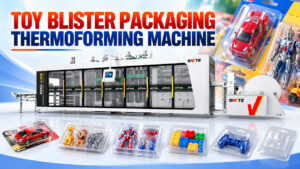
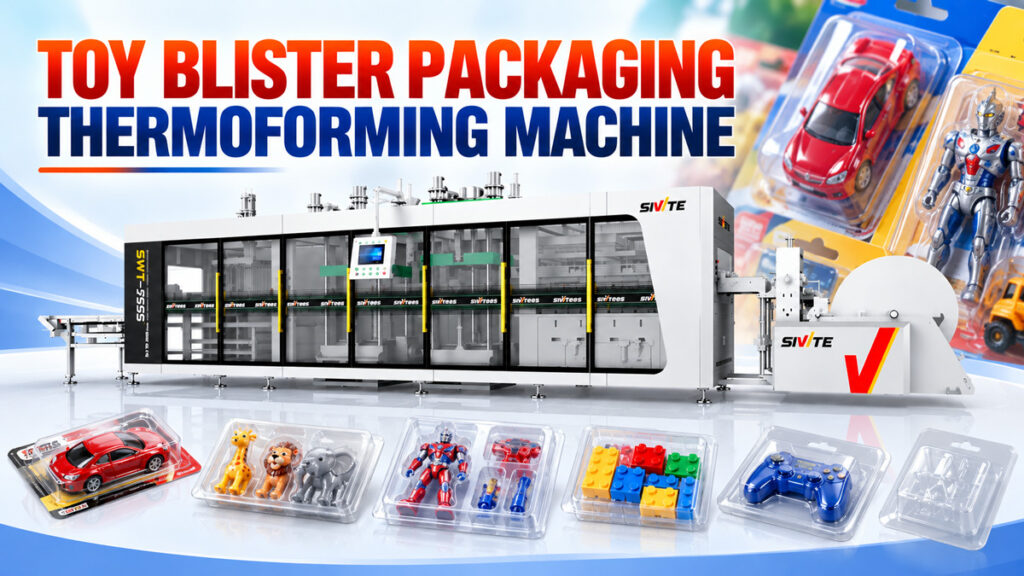
The clear plastic blisters you see holding toys onto cardboard backing cards in supermarkets and e-commerce warehouses serve two purposes — attractive retail display and protection from shifting or damage during transport. How are these blisters produced in bulk? The answer is a Toy Blister Packaging Thermoforming Machine — specifically, a positive/negative pressure 3 station thermoforming machine. This article breaks down the production process for toy blisters, what capabilities the equipment needs, and its actual output efficiency.
Common Raw Materials for Toy Blister Packaging
Toy blister packaging commonly uses three materials: PET, PS, and PVC. PET offers high clarity and better environmental profile, making it the mainstream replacement material today. PVC has good flexibility and strong performance on fine forming detail, and is still widely used for complex-shaped toy blisters. PS offers better rigidity at a relatively lower cost, suited for larger toy packaging that needs more structural strength. All three materials can be processed on the same machine, with only heating temperature and forming parameters requiring adjustment.
The Production Process for Toy Blister Packaging
The production process runs through three continuous steps — heating, positive/negative pressure forming, and punching-and-stacking — with toy blister shapes often being far more complex than ordinary packaging, demanding higher stretch uniformity.
Step 1: Heating and Softening the Sheet
PET, PS, or PVC sheet first enters the heating oven, where upper and lower heating elements evenly warm it to softening temperature. Toy shapes vary widely, and blisters often contain contours of varying depth (such as a doll’s limbs or a vehicle’s outline). Uneven heating causes insufficient stretching in the deeper sections, leading to thin walls or incomplete forming in those areas.
Step 2: Positive/Negative Pressure Mold Closing and Forming
The softened sheet moves to the forming station, where the mold closes from above and below — positive pressure actively pushes from above while vacuum draws from below at the same time — precisely stretching the sheet into a three-dimensional structure that hugs the toy’s contours, with the sealing flange around the edge (used to bond the blister to the backing card) formed in this same step. That sealing flange needs to match the card precisely to stay securely closed after high-frequency welding or heat-sealing, resisting cracking or coming loose during transport or retail display. The “push-and-pull” action of positive/negative pressure keeps the sheet stretching evenly even across complex, varied-depth shapes, clearly outperforming vacuum forming alone — a key factor in producing crisp, well-defined blisters with a secure seal.
Step 3: Punching, Separation, and Automatic Stacking
The formed blisters are still attached to the sheet at this point. The punching station uses a cutting die to precisely separate each individual blister, and the separated blisters are automatically counted and neatly stacked by the stacking system, moving straight into packaging — with no manual transfer required anywhere in the process.
One Machine Produces Toy Blisters Across Multiple Shapes and Sizes
The advantage of the 3-station positive/negative pressure thermoforming machine is that switching to a different mold is all it takes to produce blisters of different shapes and sizes. While toy products vary enormously, common blister types include:
● Figure and doll-shaped blisters: Contoured to a human-like outline, with significant depth variation
● Vehicle and model blisters: With contoured recesses to secure wheels and body details
● Multi-compartment toy blisters: A single blister divided into several small sections, used for sets with multiple accessories
● Flat hang-tab blisters: A relatively simple structure with a hang hole at the top, suited for peg-hook retail display
Regardless of how the shape varies, the machine itself doesn’t need to be replaced — only the forming mold needs adjusting, substantially lowering equipment investment for producers running multiple toy blister specs.
Production Efficiency Reference
A well-configured positive/negative pressure 3-station thermoforming machine typically reaches a forming speed of 25-40 cycles per minute when processing toy blisters (slower than simpler thin-wall cups, given the complex, varied-depth shapes). With a multi-cavity mold, hourly output can reach roughly 3,000-8,000 blisters, depending on blister size and shape complexity. The entire process runs fully automated from heating to stacking, and one machine usually only needs a single worker for end-of-line packing, significantly reducing labor cost compared to a manual, step-by-step production setup.